- WhatsApp groups for parents should be limited to school information and respect the privacy of minors.
- Sharing photos or videos of children without consent can lead to fines, civil lawsuits, and even prison sentences.
- The Spanish Data Protection Agency advises against its use as an official channel; educational platforms are the best option.
- Psychologists recommend silencing notifications and avoiding saturation to prevent generating anxiety.

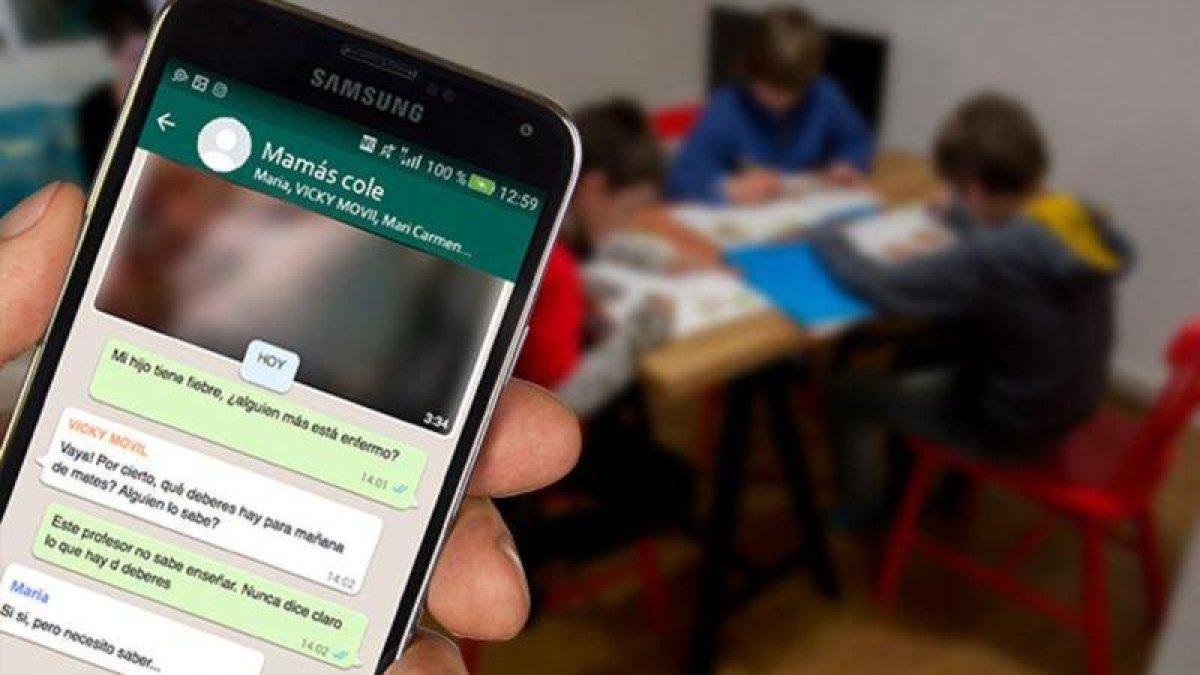
The return to school has brought with it the reactivation of the famous WhatsApp groups for parents. These chats, which remain silent during the summer, come back to life in September with an avalanche of notifications, reminders, and, occasionally, a few headaches. They are a practical tool for staying on top of homework, field trips, and school announcements, but they have also become a source of conflicts and legal problems that many are unaware of.
This year, families are also facing a landscape where children's privacy and data protection are more in the spotlight than ever. Consumer organizations, digital law experts, and psychologists agree that not everything is acceptable in these groups, and that inappropriate use can have consequences ranging from a simple argument to fines or even jail time. Below, we review the key points for using these channels without crossing the line.

What is the school WhatsApp group for (and what is it not for)?
The Spanish Consumers' Association has launched an information campaign for the third consecutive year to remind parents that these groups should be used exclusively for sharing information related to children's school education. This includes announcements about exams, schedule changes, extracurricular activities, and communications from teachers. Using them outside of this context risks overstepping boundaries and creating unnecessary friction.
The organization emphasizes that these chats should not be used to criticize the school, teachers, or even other parents . Such comments, especially if they are serious, can lead to civil and even criminal charges for defamation or slander. Furthermore, they recommend not replacing the child's planner with the WhatsApp group: parents should not become their children's "secretaries," as this diminishes their responsibility and autonomy.

It is also emphasized that parental consent must be obtained before adding children to the group . The most privacy-respecting approach is to share an invitation link so that each family can voluntarily decide whether to join. No school can force participation, as it is entirely optional.

The biggest obstacle: photos and videos of minors
One of the most sensitive issues is the dissemination of images of children. A minor's image is considered personal data protected by law, so sharing a photograph of an outing, performance, or sporting activity without the consent of their legal guardians is an infringement . Even with good intentions, such as recording a Christmas play for those who couldn't attend, it violates the right to their own image of the minors who appear in the photos without their families' authorization.
Experts warn that many parents don't perceive the risk and appreciate these moments being shared , but there's another percentage who don't want their children's images circulating online or ending up on third-party servers. Fear of social rejection often prevents them from even daring to complain, but they can file a complaint with the Spanish Data Protection Agency (AEPD) if they believe their rights have been violated.
Legal consequences: from a fine to imprisonment
What happens if that video or photo is shared without permission? The first consequence is that the content may be ordered to be removed immediately, in addition to being required to pay financial compensation for the damages caused . Civil action is based on Organic Law 1/1982, which protects honor, privacy, and image rights. In serious cases, the Spanish Data Protection Agency (AEPD) may also impose administrative sanctions.

But there's more: the Penal Code, in articles 197 and following, punishes the discovery and disclosure of secrets. Thus, anyone who uses technical means to record or reproduce images, violating another person's privacy without their permission, can face prison sentences of one to four years and a fine . And if the dissemination is especially serious, the sentence can increase to two to five years. Even someone who forwards such content knowing it was obtained illegally, without having participated in the recording, can be punished with sentences of one to three years.
An important factor is that, if the victim is a minor, the penalties are imposed in their upper half , reflecting the enhanced protection that the law affords children and adolescents. Therefore, releasing a video of a fight or a compromising situation involving a student can lead to serious legal problems.
Official channels and tips for healthy communication
The Spanish Data Protection Agency (AEPD) is clear that schools should not use WhatsApp as their official communication channel with families. They recommend using educational platforms, school-specific apps, or institutional email , as these are more secure and do not indiscriminately expose personal data.

To avoid the anxiety these groups generate, psychologists recommend silencing notifications, checking them at fixed times, and only responding to strictly school-related messages . The goal is to prevent your phone from becoming a source of stress. Before writing, ask yourself three questions: Is it true? Is it necessary? And is this the right place? If the message won't improve the situation, it's best not to send it.

They also advise against falling into "emotional contagion": a concern expressed by one parent can cause others to worry unnecessarily. And if someone decides to leave the group, they can do so naturally and without giving many explanations, as psychologist Silvia Martínez Lomas suggests: "Families, to better organize myself, I'm going to leave the group. For anything important, write to me privately. Thank you."
In the event of any serious violation, such as the unauthorized sharing of photos, a complaint can be filed with the Spanish Data Protection Agency (AEPD) or the National Cybersecurity Institute (INCIBE), which offers free advice. Ultimately, WhatsApp groups for parents are a useful tool, but they require common sense, respect for privacy, and responsible use to prevent the return to school from ending in legal trouble.
