- The Universal Commerce Protocol creates a common language between AI agents, merchants, and payment gateways to manage the entire purchase cycle.
- Google Merchant Center and consistent product data are the foundation for agents to discover, recommend, and sell your catalog.
- UCP transforms traditional SEO into search engine optimization, where feed quality and server-side measurement are key.
- Stores that prepare their technical and data infrastructure for UCP will be better positioned in the boom of conversational and agentic commerce.
The way we shop online is undergoing a revolution with the appearance of AI assistants capable not only of recommending products, but also of completing the purchase for us. In this new scenario, the so-called Universal Commerce Protocol (UCP) has become the key element that allows for the seamless connection of AI agents, online stores, and payment gateways.
Google has released UCP as an open source standard Already being tested by giants like Shopify, Walmart, Etsy, and Target, this technology will soon affect small and medium-sized businesses as well. For any e-commerce business that wants to remain visible and marketable in a world of conversational search, understanding how this protocol works and how to prepare for its integration is no longer optional.
What is the Universal Trade Protocol (UCP) and why is it so important?
The Universal Commerce Protocol is an open standard powered by Google alongside major players in commerce and payments such as Shopify, Etsy, Wayfair, Target, Walmart, Visa, Mastercard, Stripe, Adyen, American Express, and Best Buy, among others. Their main mission is very clear: to create a common language for AI-powered digital commerce.
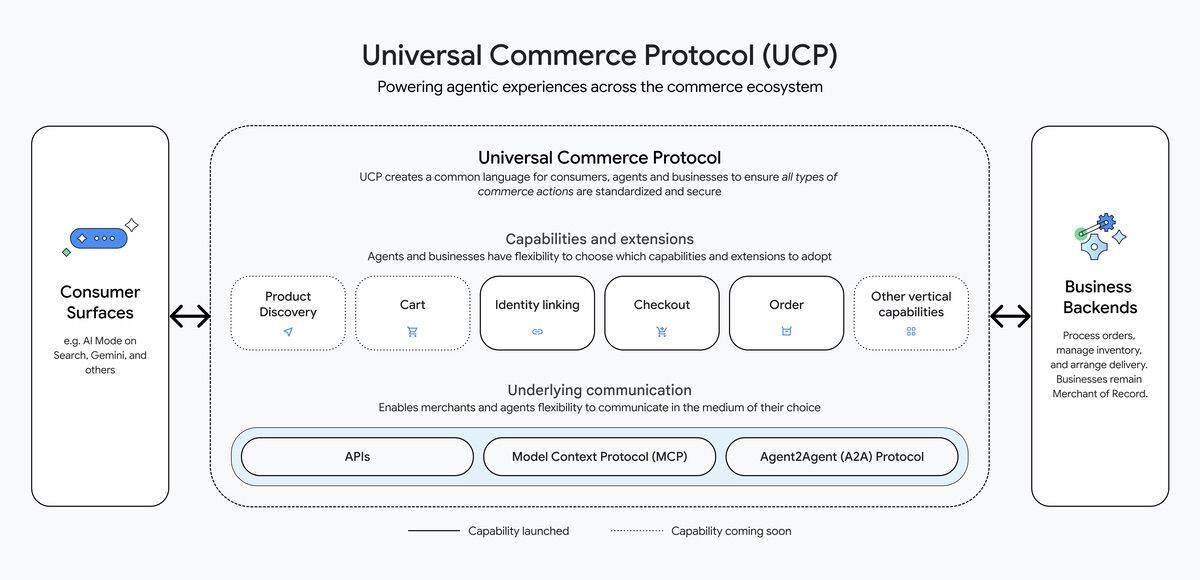
Until now, each online store had its own APIs, checkout flows, and rulesThis necessitated the development of one-to-one integrations between merchants, platforms, and assistants. With UCP, AI agents (such as Gemini or Google Search's AI Mode) have a standard way to: discover what a business can do, browse its catalog, create a cart, apply discounts, process payment, and manage after-sales service.
UCP doesn't just focus on payment; it covers the entire purchase journey.Product discovery, cart creation and updates, pricing and shipping calculations, payment processing, order generation, and subsequent status changes (shipping, returns, etc.). In practice, it's the "orchestration layer" that allows AI to handle the entire process from start to finish.
Another key point is that the merchant remains the Merchant of Record.That is, the party that maintains the contractual relationship with the customer. The protocol does not "keep" the sale; it only standardizes how the AI agent, the store's backend, and the payment providers communicate with each other.

How does UCP fit into the ecosystem of AI protocols and payments?
The Universal Trade Protocol does not come alone; it integrates with other existing standards. of the AI and payments ecosystem. Specifically, UCP communicates and is interoperable with:
- MCP (Model Context Protocol), which deals with how AI models access tools and data sources.
- A2A (Agent to Agent)designed so that different AI agents can coordinate with each other.
- AP2 (Agent Payment Protocol), the protocol that enables secure agent-based payments.
The combination of UCP with MCP, A2A and AP2 allows you to cover the entire ecommerce funnelFrom the initial conversational inquiry to the confirmation of the purchase and the tracking of the order, including recommendations, product comparison or application of loyalty programs.
In the area of payments, UCP does not replace existing solutionsbut rather works with them. For Google's current implementation, purchases are initially supported by the Standard FPAN (card numbers) saved in Google Wallet, although the design is modular and supports payment managers such as Google Pay, Shop Pay and other compatible PSPs.
How UCP works at a technical level: from the JSON manifest to the checkout session
Although UCP is flexible and extensible, its technical starting point is simple.Every business that wants to be compliant must publish a JSON file in a well-known path of its domain, usually /.well-known/ucpThis file acts as a manifesto of capabilities.
When an AI agent wants to trade with a specific business (for example, creating a shopping cart or initiating a payment), the first thing it does is consult that JSON manifestThere you will find, among other data:
- What services does the store support?: checkout, discounts, order management, returns, etc.
- What extensions does it offer?Multi-item shopping carts, points programs, coupons, special shipping options…
- Which processors or “payment handlers” does it acceptGoogle Pay, Shop Pay, proprietary payment gateway…
- Which REST endpoints should the agent use? to create and update payment sessions or orders.
Once the business profile is discovered, the AI agent initiates the transactional flow.A checkout session through a POST call to the merchant's API (defined in that manifest) and, from there, it is updated with PUT or PATCH: products are added, promotional codes are applied, taxes and shipping are recalculated, etc.
UCP's design is intended to adapt to the reality of each businessThere may be country-specific restrictions, return policies, stock limitations, or complex pricing rules. Therefore, the protocol defines common primitives but allows each backend to maintain its own business logic.
Shopping experience with UCP: what the user sees and what happens in the background
From the buyer's perspective, UCP makes possible something very simple to explain and very powerful: to buy without leaving a conversation with an AI assistant. A typical example might be a request like:
“I’m looking for a lightweight cabin-sized suitcase for under €200, with two-day delivery and good reviews.”
The AI agent consults catalogs, prices, and stock from various retailers integrated with UCP.Compare options, filter by budget, shipping times and ratings, and show several alternatives ready to buy directly from the conversational interface (AI Search Mode, Gemini app or website, or other agents that adopt the standard).
If the user decides to proceed, the assistant creates a purchase session. With the relevant store, add the suitcase to your cart, apply any available discounts, and calculate the final cost including shipping and taxes. If the buyer has their information saved in Google Wallet or another payment processor, the payment can be authorized in just a few steps.
In the background, the trade receives a perfectly structured orderThis includes an order identifier, product details, shipping address, payment method used, and any information necessary for logistics and after-sales service. Order status tracking is also updated via the API contracts defined by UCP.
Advantages of UCP for retailers, marketplaces, and content creators
For retailers, perhaps the biggest advantage is the reach and the reduction of friction.Your products can appear natively in Google AI experiences (AI Mode in Search, Gemini web and app, as they are activated) at moments when the user's purchase intent is very clear.
Furthermore, the payment process is carried out without forcing the user to jump between tabs.Forms and intermediate steps. By keeping everything within the same conversational flow, cart abandonment decreases and the purchase decision is shortened to seconds instead of minutes.
Another key point is controlThe store remains the Merchant of Record, retains ownership of customer data, and manages after-sales service, returns, and loyalty programs. UCP does not turn Google into a commercial intermediary, but rather a technical facilitator.
For publishers and content creators, UCP opens a direct monetization route of recommendations and discovery content within AI environments, without relying solely on traditional affiliate links. If an article or inspirational content is consumed in a conversational interface, the agent itself can close the sale using the protocol.
The role of Google Merchant Center in the Universal Trade Protocol
Google has made it clear that Merchant Center will remain the control panel where product data is prepared and listings and product pages are managed across its various platforms. Ensuring your data is complete, consistent, and up-to-date is a prerequisite for being "readable" by AI agents.
To prepare for UCP, it is essential to thoroughly review your Merchant Center account.: product feeds, required and recommended attributes, brand resources, return policies, shipping settings and stock availability in (almost) real time.
It is also key to activate the appropriate product attribute for native shopping experiencesIn Google's reference implementation, only listings that use the attribute native_commerce They will display the "Buy" button within the conversational flow, so it's a good idea to review which part of the catalog you want to be compatible.
In many cases, having specialized support in feed management and Merchant Center is essential. (from agencies to SaaS solutions) can make the difference between having a visible and competitive catalog for agents or falling completely off the radar.
Payment requirements and relationship with Google Pay, Wallet and AP2
In its current phase, Google's implementation for UCP primarily uses standard cards. (FPANs) that users store in Google Wallet. This allows a buyer to use payment methods they already have set up, reducing friction.
It is not mandatory for the business to have the Google Pay button integrated into its own website to participate in these experiences, but you must have a account in the Google Pay Console and Wallet and meet integration requirements.
If the merchant's payment gateway is not yet integrated with the Google Pay APIThere are specific workflows for completing the onboarding process. In cases where direct integration without going through a PSP is required, the encryption and PCI compliance documentation must be handled.
UCP, combined with the Agent Payments Protocol (AP2), ensures that payments are secure. and compatible with the existing infrastructure. The merchant declares which methods they accept, the AI agent indicates what it can offer, and the payment flow adapts to the set of options compatible between them.
Geographic availability: current situation in the United States and Europe
Google is rolling out UCP gradually and in phases.The first public rollout focuses on eligible retailers in the United States, where users can already shop directly from AI Mode in Search and from Gemini.
For Europe, the message is twofold.On the one hand, UCP has been presented as a global standard, not restricted to a single country; on the other hand, some advanced uses (such as fully automated purchases within the chat) are being tested first in the US market.
Even so, the basic principles on which UCP is based are already applied in the European market: need for consistent data, reliable feeds, compliance with payment and privacy regulations, and a technical infrastructure capable of displaying catalogs and orders in a standardized way.
For European e-commerce businesses, the time to prepare is now.: Fine-tuning your data, tracking systems, and integrations with Merchant Center will make it easier to be among the first to take advantage of the protocol when it becomes widespread.
From classic SEO to Answer Engine Optimization (AEO) and agent commerce
The arrival of UCP accelerates a transition that was already underwayFrom SEO focused on ranking URLs in search results, to optimization designed for response engines and agents (AEO: Answer/Agent Engine Optimization).
In this new model, it's not enough for your page to rank well If AI agents end up closing the purchase within the conversation, your product data, feeds, reputation, and trust signals become the primary fuel these systems use to decide what to offer the user.
For ecommerce SEO, this implies several changes in mindset.Content is still important (rich descriptions, guides, comparisons…), but now we also need to think about conversational prompts, AI-assisted journeys, and experiences where the user doesn't necessarily visit your website even if they buy from your store.
Visibility strategies involve strengthening brand authorityImplement robust structured data, maintain extreme consistency between what your pages say and what you send in your feeds, and technically enable agent commerce through UCP.
Data consistency: the basic condition for being visible to AI
With UCP, Google and other players no longer just crawl your pagesThey also evaluate the reliability of your catalog and systems. Small inconsistencies that might have gone unnoticed before can now cause an AI agent to reject your products.
Among the key signals that AI takes into account are Consistent pricing across all channels, up-to-date stock, on-time delivery, well-applied promotions, and clearly defined variants (sizes, colors, packs, etc.).
Modern ecommerce platforms (Shopify, WooCommerce, Magento…) They already centralize a good part of that information, but that does not automatically guarantee that the data meets UCP's expectations or that it is synchronized in real time with all channels.
It is essential to thoroughly audit your data flows: what source is considered the “reference system” (ERP, PIM, CMS), how data travels to Merchant Center, what delays there are in updating stock, and whether promotions are correctly reflected across all surfaces.
Trusted solutions (seals, verified reviews, certifications) They also play an additional role: they reinforce the security perceived by users and provide an additional layer of "algorithmic trust" that agents can use as a signal, although in no case do they replace the consistency of the data.
Impact on tracking, measuring, and attributing conversions
One of the major challenges that UCP brings is measurement.When a purchase is initiated and completed within Google's AI Mode or Gemini, traditional browser-based scripts may not detect it correctly.
To avoid lost or duplicate conversions, merchants need to confirm orders from the server., capturing order ID, amount, currency and timestamps regardless of the payment flow in the interface.
The attribution also becomes more complicatedA sale completed within a conversational experience doesn't fit well into traditional "source/medium" models. Attribution models and dashboards will need to be adjusted to differentiate traffic and purchases originating from the user-centric approach (UCP) versus those occurring on the company's own website or app.
Practical steps to prepare your ecommerce for UCP
Beyond theory, any online store that wants to be UCP ready A concrete roadmap should be drawn up, which includes at least the following areas:
- Configure and optimize Google Merchant Center: shipments, returns, attributes, feed quality and activation of products eligible for native payments.
- Request access to UCP programs When they become available in your region, join waiting lists and carefully review the Google Developers documentation.
- Publish a UCP profile on
/.well-known/ucp, where supported services, commercial extensions, supported payment processors, and integration endpoints are described. - Enable checkout and order management APIs that function as true programmatic services and do not depend on "fixes" in the front-end.
- Sync orders and statuses with Google through webhooks or other mechanisms that allow real-time status updates.
In parallel, it is advisable to review the content strategy and technical SEO. to adapt it to conversational searches, include complete information on shipments and returns, reinforce structured data, and work on brand authority in an environment where agents are increasingly making decisions.
UCP, small businesses and intermediate solutions
All of this may sound distant to startups and SMEs that sell online and don't have large technical teams. However, UCP's design itself is intended to allow platforms (Shopify, marketplaces, SaaS solutions) to offer ready-to-use integrations.
There are already examples of major initial partners such as Walmart or Sam's Club These features allow direct purchases from Gemini with real-time catalogs, pricing, and availability, and even the linking of loyalty accounts. It's reasonable to expect that, in the medium term, popular CMS and e-commerce solutions will incorporate native support for the protocol.
For smaller businesses, the realistic recommendation is to focus on three pillars.: clean and complete product data, solid integration with Merchant Center, and measurement systems ready to capture orders that do not go through the classic site checkout.
As the ecosystem matures, compatibility with AI agents and UCP will increase. It will be less of an experiment and more of an entry requirement to the digital market, just as having a decent CMS or accepting card payments are today.
The Universal Trade Protocol aims to become something akin to the “HTTP” of AI-powered commerceInvisible to the end user but absolutely critical for searches, recommendations, payments, and after-sales service to flow seamlessly between AI agents, merchants, payment gateways, and content platforms. Preparing your data, infrastructure, and strategy now for this new context will put you several steps ahead when conversational shopping ceases to be a novelty and becomes the norm.