- Technology combines scientific knowledge and practical skills to create solutions that transform resources into useful products and services.
- Technological revolutions, from the Stone Age to the digital age, have brought about profound changes in the economy, work, and social organization.
- ICTs allow information to be stored, processed and communicated on a large scale, driving a new, increasingly connected technological society.
- Technology applied to personal autonomy and accessibility is key to preventing dependency and promoting active aging and inclusion.
La Technology is part of virtually everything we doFrom turning on the lights in the morning to sending a message or booking a doctor's appointment online, we often use mobile phones, computers, or household appliances without stopping to think about what's behind them, what technology really means, or how we got to this highly digitized situation.
Discover the basic technology concepts It helps us better understand the modern world, its advantages, and also its risks. Throughout this article, we will explore what technology is, how it has evolved through various technological revolutions, what role ICTs play today, and how it is being used to improve personal autonomy, accessibility, and quality of life, especially for those most at risk of dependency.
What is technology and what elements make it up?
When we talk about technology, we're not just referring to mobile phones, computers, or sophisticated machines; in reality, Technology encompasses any solution created by humans. to solve a problem or satisfy a need, combining knowledge, skills, and material and organizational resources.
From a broad perspective, technology includes both tangible artifacts (tools, devices, machines, infrastructures) such as intangible elements (organizations, work methods, Software(rules and procedures). All of this works thanks to people who design, manufacture, use, maintain, and improve those systems.
In more academic circles, it is often said that technology is the coordinated application of scientific knowledge (science) and practical skills (The technique) for creating technological solutions. These solutions allow human beings to satisfy very diverse needs: to eat better, communicate over long distances, travel faster, take care of their health, learn, work, or be entertained.
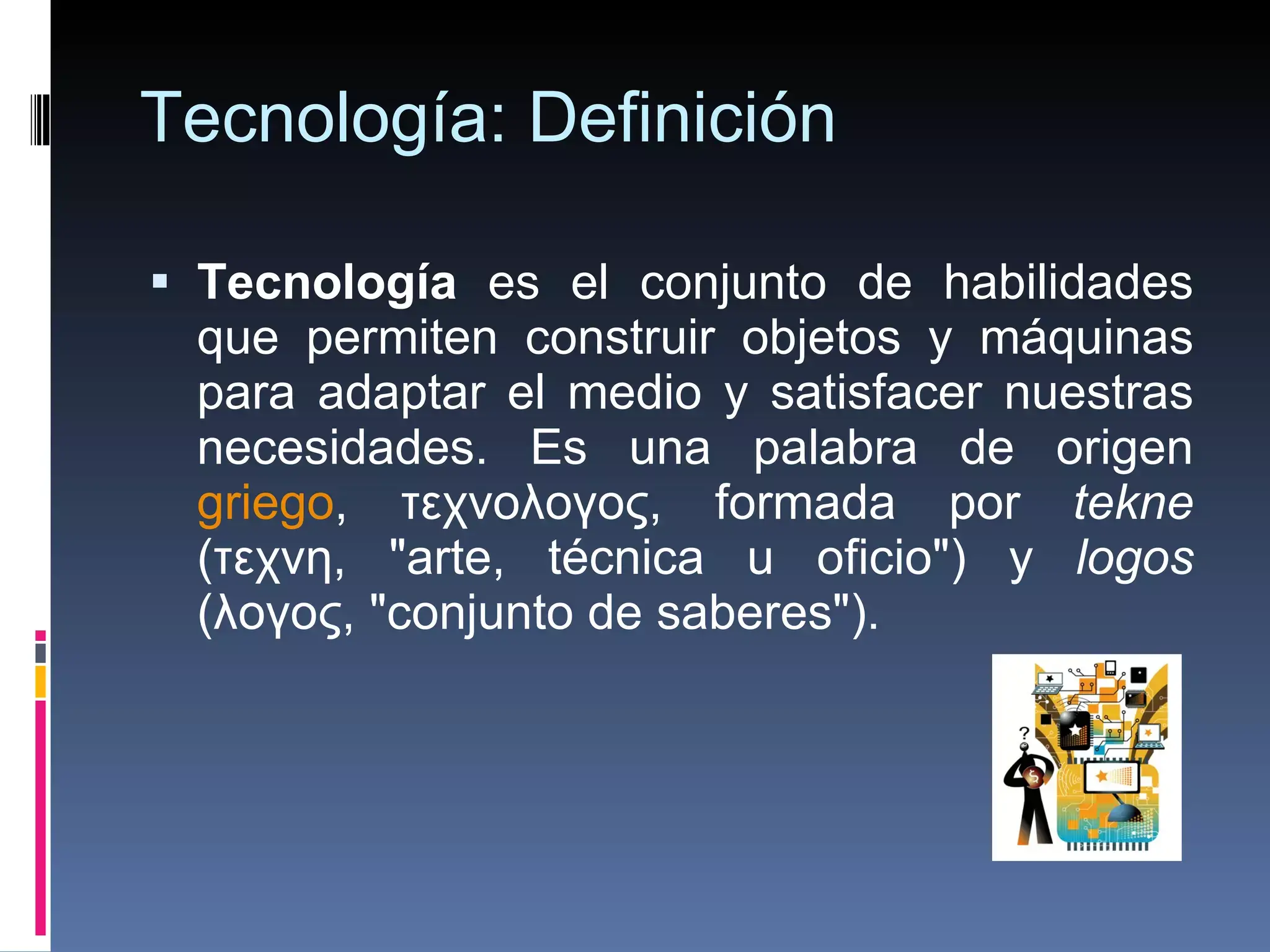
The term technology comes from Greek: on the one hand, “tékhne” refers to art, technique, or craftOn the other hand, “logos” refers to the body of knowledge or wisdom. Together they form the idea of organized practical knowledge that serves to intervene in and transform the environment.
Furthermore, when written in capital letters, Technology can refer to the discipline that studies the principles common to different technologies, or the subject of technological education in school, where students become familiar with the most important technological objects, processes and systems of everyday life.
Technological processes: much more than using devices
Behind every invention, digital service, or household appliance lies a chain of activities that we rarely see. These Technological processes are sets of successive phases that transform resources (materials, energy, information, time, money) into products or services that meet specific needs.
A technological process involves complex decisions that combine clear purposes, available resources, and appropriate proceduresIt is not enough to have a good idea: you have to plan how it is designed, how it is manufactured, how it will be distributed, how it will be maintained, how quality will be controlled, and how the results will be evaluated.
In simplified terms, a technological process typically includes activities such as product or service designTask planning, logistics for obtaining and moving materials, manufacturing or commissioning, maintenance, measurement (metrology), evaluation, and quality control. All of this can be very simple or extremely complex depending on the case.
To get an idea of the diversity, let's think about the difference between to make a garment from artisanal production to managing a large petrochemical plant. In both cases there are technological processes, but the degree of complexity, the type of resources, and the levels of automation change completely.
That is why it is often said that Technology is not just “gadgets”They are also processes, work organization, decision making and coordination of many people so that a final result reaches our hands safely, usefully and at a reasonable cost.
Technological revolutions throughout history
Throughout human history, several events have occurred technological revolutionsThat is, periods in which there are advances, innovations or changes so profound that they completely transform the organization of society, the economy and daily life.
These leaps don't just affect machines or tools; they have an impact on the science, the economy, the way of workingProduction and management models in companies, and also in areas such as ecology, education, health, food, and communications. Let's review the most significant historical milestones.
Stone Age: First tools and control of fire
In prehistory, the first humans began to manufacture simple tools made with sticks, stones, and bonesAlthough they may seem rudimentary to us today, they represented a huge change in their ability to hunt, process food, build shelters and defend themselves.
One of the most decisive advances was the fire masteryBeing able to light and maintain fire allowed for the transformation of food composition through cooking, improving digestibility and food safety, and using flame to obtain heat in homesto illuminate at night and scare away dangerous animals. Thanks to this, human life was no longer strictly limited to daylight hours.
Ancient History: the wheel and the first calculating devices
In ancient times, innovations occurred that, viewed in retrospect, completely changed the agricultural and economic systems of the era. One of the most significant was the invention of the wheel around 5.000 BC in Mesopotamia, considered by many specialists as the first great technological revolution due to its enormous impact on transport and many production processes.
Later, around 2.700 BC, the abacusThe calculator, a calculating device that facilitated numerical operations, represented a first step towards the mechanization of information processing. These contributions helped ancient societies to better manage their harvests, trade, and administrative records.
Middle Ages: the compass and the expansion of navigation
During the Middle Ages, one of the decisive inventions was the compasswhich became popular around the 9th century. This simple instrument greatly improved maritime navigation by providing a relatively reliable reference for direction even in poor visibility.
Thanks to the compass, Maritime trade routes became safer and more predictable.This spurred the exchange of goods, people, and ideas between distant regions. Although it is not always mentioned as much as other inventions, its role in the economic and cultural development of humanity was enormous.
Modern Age: printing press, microscope and the beginning of industrialization
The Modern Age was marked by several powerful inventions. One of the most symbolic was the movable type printing press in the 15th century, which drastically reduced the cost of producing books and allowed an unprecedented spread of knowledge, religion, and political ideas.
At the end of the 16th century, the microscopewhich opened the door to observing structures invisible to the human eye and laid the foundations for the subsequent development of biology, medicine, and many branches of experimental science.
Already in the 18th century, the steam engine and the telegraphThe steam engine enabled the mechanization of production processes and transportation (trains, ships), while the telegraph revolutionized long-distance communication. All these advances gave rise to what was called the Industrial Revolution. First Industrial Revolution.
First Industrial Revolution
The First Industrial Revolution marked the transition from an economy based primarily on agriculture and crafts to one in which Factories and machines played a leading roleCities grew, the organization of work changed, and new professions related to industry and engineering emerged.
Second Industrial Revolution
Between the end of the 19th and the beginning of the 20th century, the so-called Second Industrial RevolutionThis period was characterized by a new set of technological and social transformations. Key inventions of this era include the electric light, the phone and the standardization of the first cars.
This period saw the consolidation of large transportation and communication networks, as well as mass production. Many historians consider it the major set of economic, technological and social changes since the Neolithic period, due to the boost it provided for agriculture, trade, and industry on a global level.
Third Industrial Revolution or Post-Industrial Age
During the 20th century, a new wave of changes appeared linked to the Information technology and telecommunicationswith the invention of the first computers, wireless phones, the internet and, later, the World Wide Web (WWW), the great global network that connects computers and information on a global scale.
This Third Industrial Revolution, also called Post-industrial AgeThis led to a more service- and information-based economy, where data processing, automation, and instant communication became central to the production system.
Towards the Internet of Things and the Fourth Industrial Revolution
Technological evolution continues, and in recent decades we have entered a phase marked by the development of internet of things, the connection of devices to each other (mobiles, sensors, household appliances, cars, industrial machinery) and the planned deployment of technologies such as 5G.
To describe the current stage, we usually talk about Fourth Industrial Revolution, also known as the scientific-technological revolution or the revolution of intelligence and digitization. In this context, the microelectronics, Big Data, Cloud Computing, social networks, the Artificial Intelligence And the R&D-focused sectors are profoundly changing industry, services, and the organization of work.
Technology today: digital society and well-being
From the times when the great advance was lighting a fire or carving a stone to today, the leap has been immense. Nowadays, when we talk about technology, we usually think of the use of scientific knowledge applied to devices, applications and tools that allow us to design and create goods or services that facilitate our adaptation to the environment.
Contemporary technology aims to provide response to both individual and collective needsFrom communicating with our family to managing healthcare, education, financial, or leisure services, all of this has a direct impact on improving our quality of life, provided it is used responsibly and accessibly.
The era in which we live is characterized by being a true digital transformation stage of society. The production of goods and services, their distribution and their marketing are increasingly supported by complex technological systems, where the energy factor and the intelligent management of information play a crucial role.
All scientific and technical activity is located in Continuous movementEvery innovation opens new possibilities, but also poses ethical, labor, and environmental challenges. In theory, the goal of such development should be human well-being and social and economic progress, balancing growth with sustainability and social justice.
As happened with the wheel in Mesopotamia, Current technologies are occupying central spaces in our livesIn exchange for a necessary adaptation (learning new skills, changing habits, updating infrastructure), they offer us advantages such as saving time and effort, convenience, and new forms of relationship and participation.
ICTs: Information and Communication Technologies
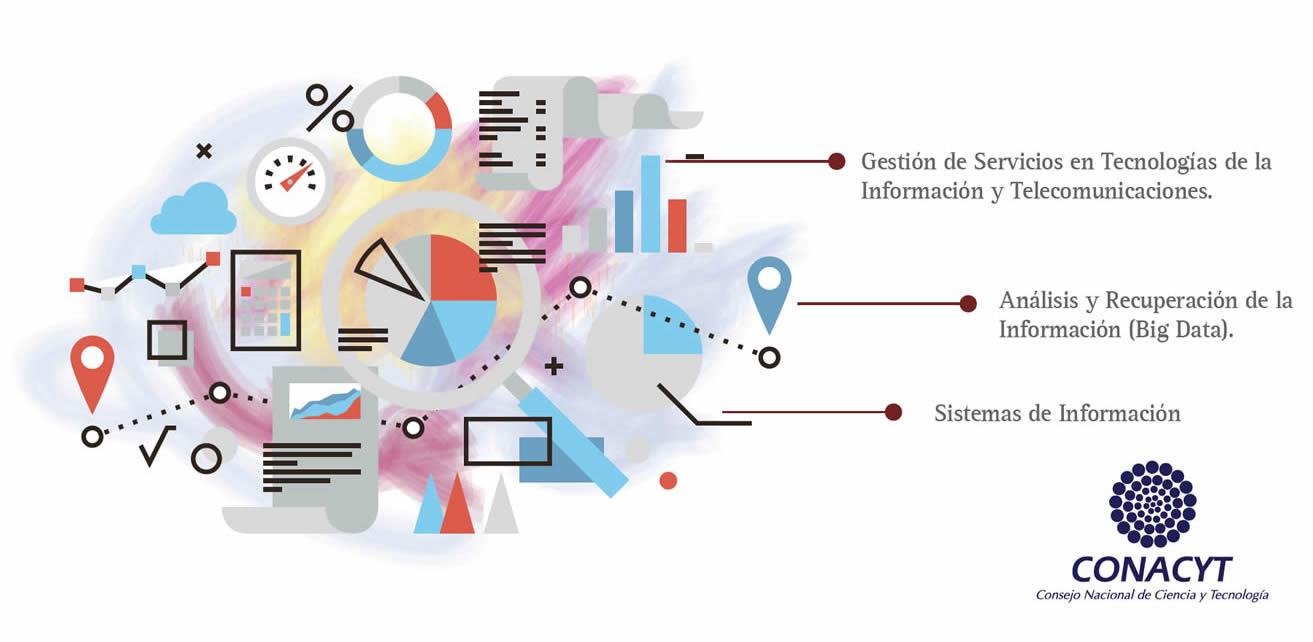
Within the vast technological universe, the so-called ICT (Information and Communication Technologies) They have acquired enormous prominence. This name encompasses all those products and systems capable of storing, retrieving, manipulating, transmitting, or receiving information electronically and digitally.
This includes everything from computers and smartphones, tablets and connected TVs...to communications networks, servers, cloud systems, messaging platforms, social networks, and much more. Thanks to ICT, Information circulates at a speed and on a scale unimaginable just a few decades ago..
In everyday life, this translates into actions as commonplace as monitor our heart rate with a smartwatch, book an appointment at the health center through an application, check news and events in real time or make video calls with people who are thousands of kilometers away, overcoming time differences and physical distances.
Although many of these tasks may now seem like small, routine gestures, together they push us towards a new model of technological society, in which connectivity and the massive processing of data are transforming areas such as health, transport, education, communications or leisure.
Technology, personal autonomy and active aging
One of the fields where technology is making a particularly significant contribution is that of personal autonomy, prevention of dependency and active agingThe goal here is not only to make life more comfortable, but also to guarantee rights, accessibility, and equal opportunities.
Various public institutions and social organizations are promoting resources and tools so that people with disabilities, older people, or those with comprehension difficulties can to take advantage of technology without being excludedAn example of this is the work carried out by the Royal Board on Disability.
This organization has produced, for example, a Guide to accessible mobile applicationsDesigned to help identify and use apps that meet accessibility criteria and are truly useful for people with different types of disabilities, this resource ensures that technological advances don't just benefit those who already have more advantages.
Work has also been done on documents about the gender perspective in accessibility and in assistive products for women and girls with disabilities. It is important to keep in mind that technology does not have the same impact worldwide, and that specific gaps may exist that affect certain groups more if inclusive policies are not designed.
Many of these materials are offered in easy readingThat is, with language and format adapted to make them more understandable for people with reading or comprehension difficulties. We find, for example, guides for downloading and using the Cl@ve PIN system, or for requesting the digital certificate online, explained step by step in an accessible way.
The underlying idea is that technology can be a a fundamental tool for maintaining autonomy and social participation for the elderly or disabled: from medication reminders and telecare devices to online training platforms or adapted communication systems.
Similarly, informational materials and guides are being published so that any citizen can carry out digital procedures more easily and reliably. This includes learning how to securely identify themselves, understanding what a digital certificate is, and how personal information is protected in these systems.
When good technological design, universal accessibility criteria, and training support are combined, Technology becomes a powerful ally to age more actively, maintain social relationships, access public services and exercise rights with greater independence.
Looking at this entire journey, from the first stone tools to artificial intelligence and accessible mobile applications, one can appreciate how Technology has been and continues to be a constant driver of social changeUnderstanding its basic concepts, processes, and implications allows us to use it more judiciously, demand that it be inclusive, and leverage it to improve people's lives without leaving anyone behind.