- Spotify introduces the green "Verified by Spotify" badge to highlight human artist profiles against the avalanche of AI-generated music.
- Verification requires real-world presence outside the platform, sustained activity, and compliance with standards, excluding projects primarily based on AI.
- The badge will be rolled out progressively on a global scale and already covers more than 99% of the artists that users actively search for.
- The measure joins other contextual tools such as DDEX-standard AI credits and SongDNA, in an attempt to bring order to the new music ecosystem.
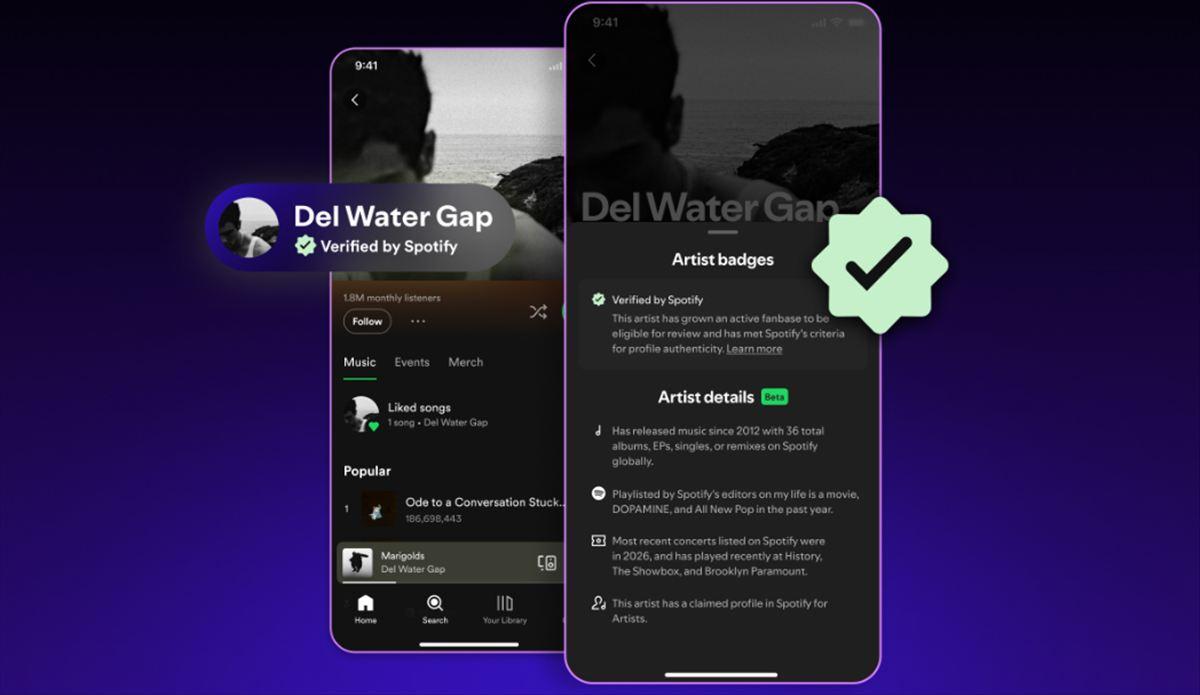
Music in Streaming platforms have been coexisting for some time with a problem that is now impossible to ignore: the explosive growth of songs and profiles created with artificial intelligenceBetween endless lists of new releases and unfamiliar names, knowing whether a song is created by a person or an algorithm has become increasingly difficult for listeners.
To try and bring some order to this situation, Spotify has introduced a new global badge called Verified by SpotifyA verification seal with a green checkmark aims to identify human artists with real activity and verifiable track records. The idea is to offer a clear reference to users and, at the same time, send a message to the industry: authenticity is becoming a central criterion within the catalog.
What is "Verified by Spotify" and why is it coming now?
The new badge consists of a green verification icon accompanied by the text "Verified by Spotify" This badge will appear on artist profiles and next to their names in search results. Unlike the old blue "verified artist" badge or the "registered artist" label, this badge doesn't just confirm who manages the account; it introduces an editorial criterion: distinguishing human profiles from those based primarily on AI.
Spotify openly acknowledges that the context has changed. In recent years, the fake profiles, music spam, and inflated catalogs with algorithm-generated tracks, many optimized to sneak into background playlists or exploit loopholes in the royalty system. The company acknowledges that traditional verification has fallen short in an environment where anyone can produce dozens of synthesized songs in a matter of minutes.
At the program's launch, the platform claims that over 99% of the artists that users actively search for They already have the badge or will receive it in the coming weeks. They are mostly independent musicians from different genres, career stages, and regions, including Europe and Spain, where streaming has become the main way to consume music.
This move is part of a series of broader changes. In late January 2026, Spotify had already adjusted its verification system, replacing the blue "Verified Artist" badge with the "Registered Artist" category. "Verified by Spotify" is a further step: introduces a visible boundary between human profiles and projects guided by artificial intelligence.

How to obtain the seal: real presence and sustained activity
To award the badge, Spotify doesn't rely solely on internal metrics. The company assesses whether the profile represents... a real creator with an identifiable presence both on and off the platform. This includes elements such as concert dates, official merchandise, and social media accounts linked to the artist's profile.
The platform places special emphasis on the activity and long-term engagementThe label is designed for artists that listeners seek out regularly and deliberately over an extended period, not for projects that experience a fleeting spike in plays and then disappear. This approach downplays ephemeral viral phenomena and favors those who maintain an ongoing relationship with their fanbase.
Furthermore, the company clarifies that the verification is a living and continuous processThe fact that an artist doesn't have the badge today doesn't mean they can't get it later. As a project solidifies its career, adds concerts, strengthens its public presence, and generates sustained interaction, it may meet Spotify's eligibility criteria.
In parallel, the platform will combine automated tools with human review to analyze the profiles. The stated objective is to differentiate between artists acting in good faith and abusive or deceptive behavior, avoiding both false positives and the unfair exclusion of emerging musicians.
Who's left out: AI, synthetic characters, and "functional" music
Although Spotify insists that the concept of authenticity is complex and rapidly evolving, the company has drawn some clear lines. Profiles that appear to primarily represent AI-generated artists Virtual characters built entirely with this technology will not be able to access the green seal, at least for now.
Also excluded are projects that fit what the platform defines as "functional music"Content designed almost exclusively for passive listening, such as certain lo-fi catalogs for studying, relaxing piano playlists or ambient music for concentration, often mass-produced and algorithmically optimized to fill gaps in the lists.
This distinction is not technical, but editorial. Spotify is establishing a boundary between the music understood as a cultural productwith a community of listeners and impact on the scene, and music treated as background music. The verification seal is reserved for the first category, which relegates a good number of releases intended to accompany tasks, work, or sleep to a secondary position.
The decision is not without its frictions. There are human creators who work in the realm of ambient, meditative electronica, or minimalist soundtracks, often with deliberately discreet approaches and without major tours or merchandising campaigns. Some might get trapped in the same category as purely algorithmic catalogs, despite their artistic contribution.
Spotify acknowledges that it will have to adjust this approach over time, as the uses of AI in music creation evolve and the role of these more subtle approaches becomes clearer. For now, the priority is to distance itself from profiles that rely almost entirely on automated content generation.
Where is the badge displayed and how does it affect the user experience?
The "Verified by Spotify" badge will be prominently displayed. on the main page of each artist's profile that meets the requirements, and also alongside their name in the search results. For the user, this provides a quick reference to know if they are interacting with a musician with a proven identity and track record.
The badge is not applied song by song, but to the profile setIn other words, a verified artist can use AI tools at some stage of production, as long as the account represents a real person or group, with control over what is published and with demonstrable activity outside the digital environment.
The rollout will be gradual. Spotify notes that it needs to review millions of artist and creator profilesTherefore, the badge's rollout will be gradual and will expand over time. The company emphasizes, however, that the vast majority of names users regularly search for are already included in the first wave.
For those who listen primarily on their mobile phones, the new feature will come with a new section in beta within the "About" section on profiles. This area will display relevant milestones in the artist's career, upcoming releases, tours, and other details designed to reinforce the perception of authenticity, even on accounts that do not yet have the green checkmark.
Relationship with other measures against AI and context in Europe
The launch of "Verified by Spotify" is not an isolated event. In recent months, the company has been rolling out song-level context functions, such as specific credits to indicate where and how artificial intelligence has been used in the production of a track. To this end, it collaborates with the DDEX standard, which aims to create a kind of "nutritional labeling" that informs the listener about the role of AI in each track.
In addition, there's SongDNA, a tool designed to explore the creative connections behind each songFrom the composers and producers involved to their connections with other releases, everything fits into a clear strategy: to offer more information about the context of the music and who is behind it.
In this context, Spotify's decision is interpreted as an attempt to align with the growing regulatory demands And, at the same time, maintain the trust of listeners and creators in key markets like the European Union. Distinguishing the human from the purely synthetic is no longer just an interface gesture; it's becoming a central element in the discussion about transparency and accountability in the use of AI.
The measure, in any case, does not prohibit artificial intelligence in music creation. Rather, it attempts to establish a clear line of responsibility: who signs the profile, who is responsible for the work, and how the public is informed about the technological intervention.
With this new green label, Spotify takes a significant step towards organizing a catalog increasingly saturated with algorithmic productions, reinforcing the visibility of human artists with a real presence both on and off the platform. Although the system still needs refinement and there will be borderline cases that generate debate, the company is sending a clear signal: in a sea of AI-generated music, verifiable authenticity is becoming a differentiating value that they want to explicitly recognize and highlight to listeners.