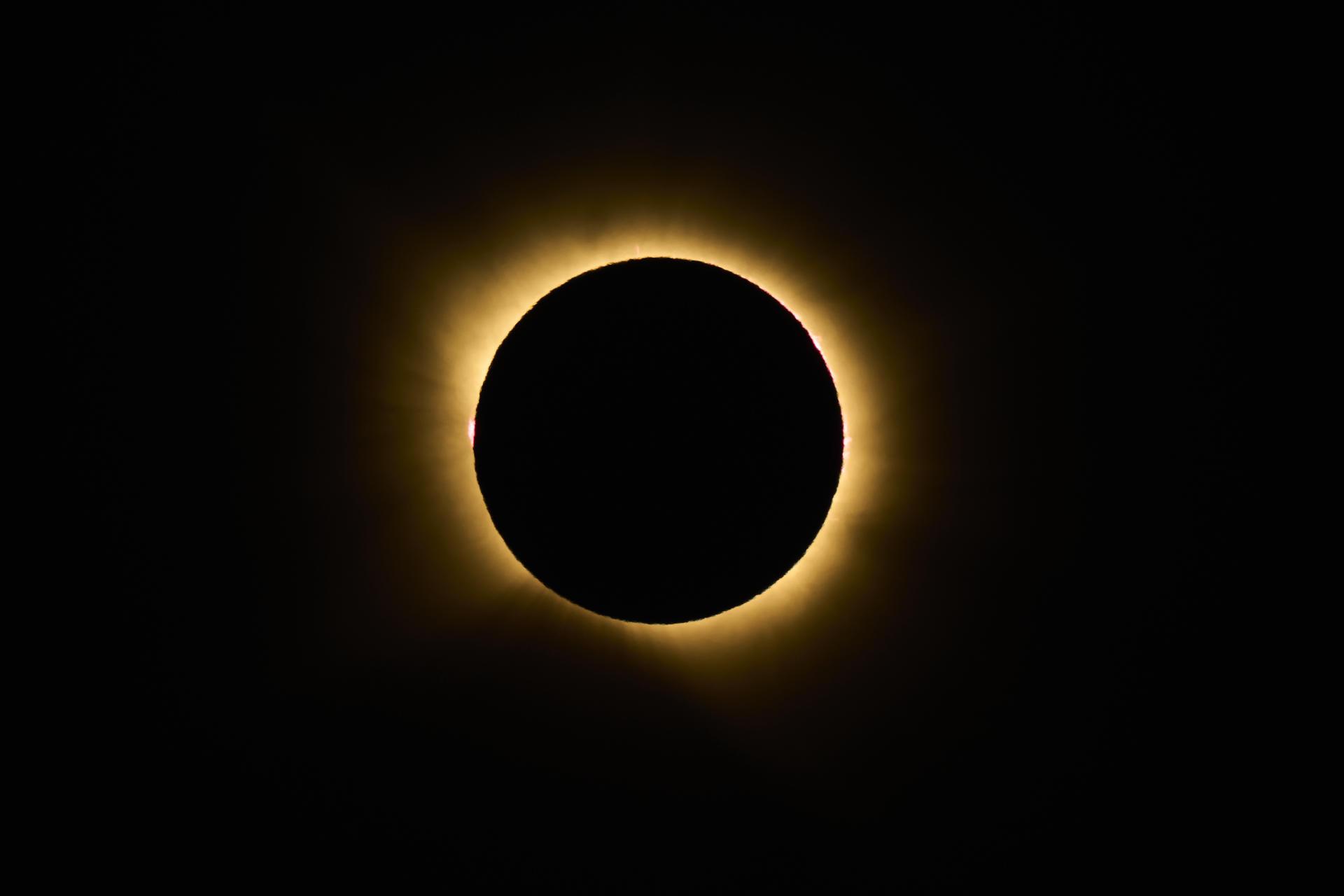
- The Government is coordinating with 13 ministries and experts the operation for the total eclipse of August 2, 2027.
- The coverage area will cross the Strait of Gibraltar and southern Andalusia, with Ceuta and Melilla among the most privileged areas.
- In some places the total darkness will exceed four minutes and the phenomenon may reach a maximum duration of up to six minutes.
- The figures for the 2026 eclipse serve as a guide: 2,1 million displaced people, 26 million extra trips and two million certified glasses.

The Spanish government has begun preparations for the total solar eclipse of August 2, 2027, an event experts consider among the most significant of the century due to the duration of the totality phase. The Interministerial Commission for the Trio of Eclipses, chaired by the Secretary of State for Science, Innovation and Universities, Juan Cruz Cigudosa, met this Thursday at the Ministry of Science, Innovation and Universities to coordinate actions. During the meeting, Cigudosa expressed his gratitude for the effort and coordination of all those involved in the 2026 eclipse and emphasized that the upcoming event will demonstrate Spain's ability to manage an event of great scientific, social, and tourism importance effectively, safely, and rigorously.
This event will be no ordinary phenomenon. The southern part of the Iberian Peninsula, Ceuta, and Melilla will fall within a path of total darkness that will also extend across the Strait of Gibraltar and the Alboran Sea. Following the experience of the 2026 eclipse, the government aims to refine its organization in terms of mobility, security, public health, outreach, and tourism promotion to ensure that the large influx of visitors does not become a problem.

An exceptional array of views and times to gaze at the sky

The eclipse will occur in the morning , a detail that will make it especially striking: daylight will abruptly fade, and the sky will be able to reveal stars and planets for a few minutes. In Spain, the phenomenon will begin around 09:30 a.m., and totality will occur approximately between 10:45 and 10:50 a.m., with variations depending on the municipality.
The maximum duration of the eclipse, at the best vantage points on the planet, will be around six minutes . In Egypt, near Luxor, totality could last approximately six minutes and 23 seconds, while in southern Spain, some areas will experience more than four minutes of complete darkness. This figure far surpasses the eclipse of 2026 and explains the scientific and touristic interest.
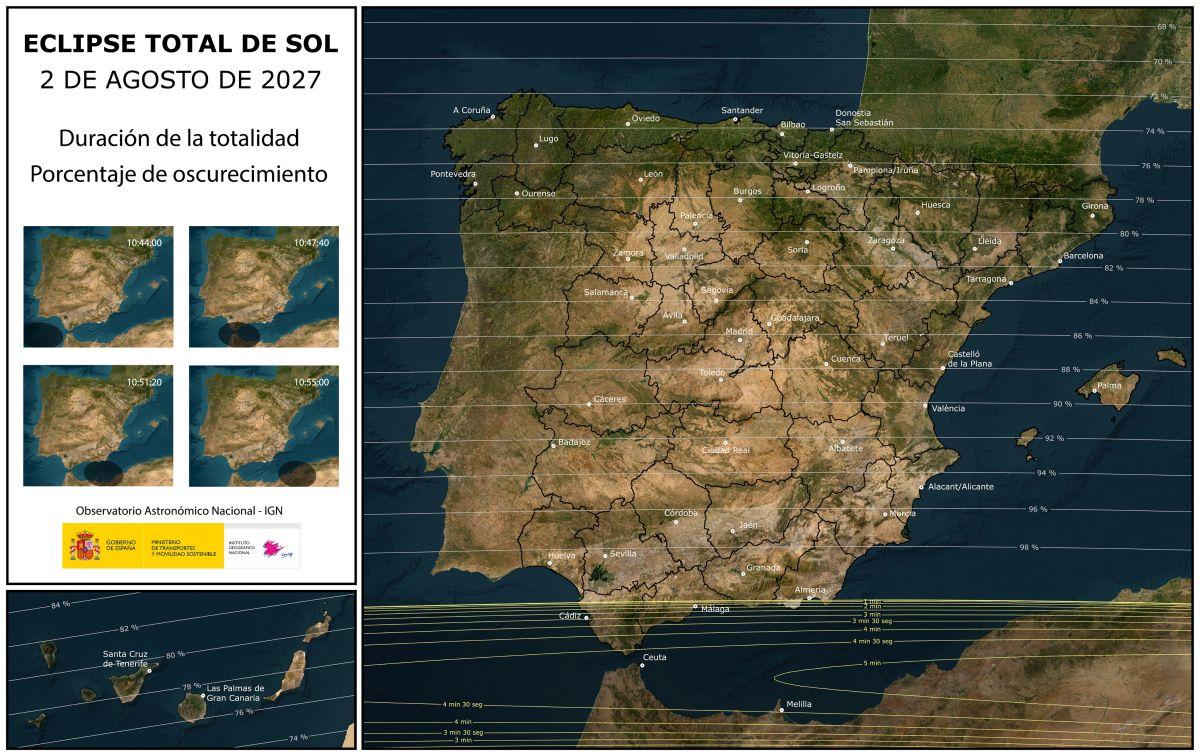
Within Spanish territory, the path of totality will include the Strait of Gibraltar and the Alboran Sea . The provinces most affected will be Cádiz, Málaga, Granada, and Almería, as well as the autonomous cities of Ceuta and Melilla. Outside this path, such as in the Basque Country and other northern regions, the eclipse will be seen as a partial eclipse.
- Andalusia: The coastline of Cadiz, Malaga, Granada and Almeria will have part of its territory under complete shade.
- Ceuta and Melilla: They are among the areas with the longest expected duration of the total.
- Rest of Spain: The obscuration will be partial, without total darkness, unless you travel to the strip.
The 2026 trial yields millions in data
The commission meeting served to review the report on the total eclipse of August 12, 2026, the first major event of the Trio of Eclipses . That day saw 26 million more journeys than usual for an August day, representing a 21% increase, according to data from the Ministry of Transport and Sustainable Mobility.
The report also notes that over 2,1 million people traveled to the area of totality, 48% more than on a typical day. The phenomenon acted as a powerful tourist magnet and helped boost astrotourism, showcasing destinations and infrastructure that can remain active beyond the specific date.
In terms of health, no public health incidents of national significance were identified , nor was there a significant overload of the National Health System in the days that followed. To facilitate safe viewing, the commission distributed two million certified eclipse glasses and implemented prevention, safety, and mobility plans in coordination with regional governments and municipalities.
The 2026 operation involved 13 ministries and experts from the National Astronomical Observatory, the Canary Islands Institute of Astrophysics, and the Institute of Astrophysics of Andalusia. According to the report, there were no serious disturbances to public order, significant fires, or incidents that significantly threatened public safety or health.
The scientific aspect also yielded results. Research led by the Spanish National Research Council (CSIC) and the Canary Islands Institute of Astrophysics advanced our understanding of the Sun's magnetic activity and the solar corona, as well as improving solar prediction models—a key field due to the impact of space weather on satellites, telecommunications, and other technological infrastructure. The Yebes monitoring center in Guadalajara, a joint initiative of the Ministry of Science and the Spanish Foundation for Science and Technology (FECYT), brought together more than 130 journalists and hosted a broadcast of the Spanish Television program "Aquí la Tierra" (Here on Earth), which reached 2.658.000 viewers and a market share of over 30% during its peak minute.
Preparations for a summer with high tourist pressure
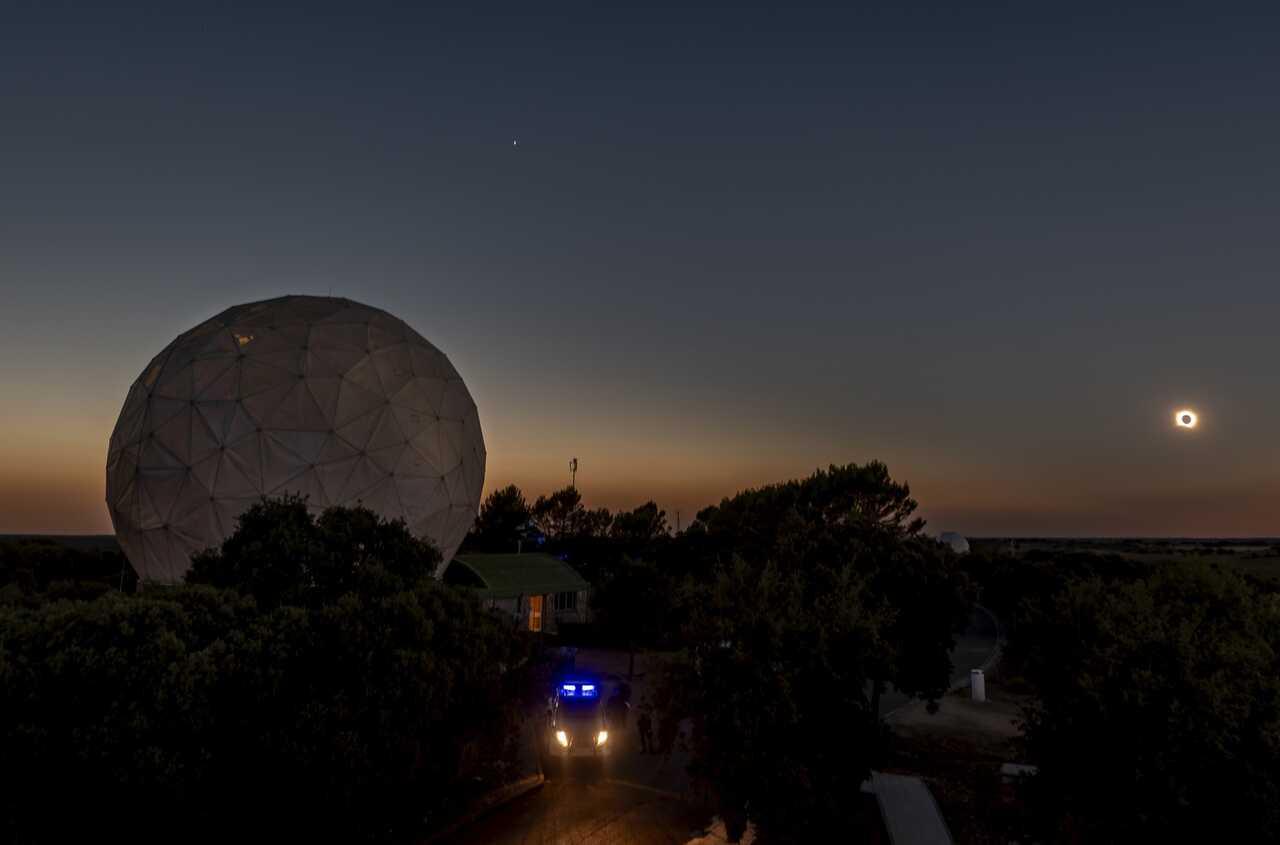
With an eye on 2027, the government wants to anticipate the bottlenecks that an event of this nature could generate. The commission meeting in Madrid is working in coordination across transport, mobility, security, civil protection, health, science, and tourism, with the autonomous communities as invited participants and paying particular attention to the Strait of Gibraltar area and southern Andalusia.
The tourism sector is already feeling the impact. In regions like Campo de Gibraltar , within the path of totality, high demand for accommodation is expected for the night of August 1-2. The experience of 2026 serves as a warning: when a total eclipse coincides with peak season and popular coastal areas, hotel capacity and travel become the main challenge.
The Interministerial Commission for the Trio of Eclipses includes representatives from the Ministries of Transport and Sustainable Mobility; Defense; Finance; the Interior; Education, Vocational Training and Sports; Industry and Tourism; Territorial Policy and Democratic Memory; Ecological Transition and Demographic Challenge; Culture; Economy, Trade and Business; Health and Social Rights, Consumer Affairs and the 2030 Agenda; Agriculture, Fisheries and Food, as well as astronomical experts. Its objective is to ensure the event unfolds safely, rigorously, and effectively.
The astronomical calendar doesn't end in 2027. The so-called Trio of Eclipses began with the total eclipse of 2026 and will continue with the annular eclipse of January 26, 2028. Even so, the event on August 2, 2027, will be the one that focuses attention in southern Europe due to its duration and the fact that totality will be visible from Spanish territory.
What is known about the eclipse that will mobilize the south
The combination of summer, coastline, and total darkness in the middle of the morning makes the 2027 eclipse a phenomenon with enormous potential for Spain. The 2026 experience included the distribution of certified eclipse glasses and preventative health measures, a type of action that will be coordinated again to avoid risks during the viewing.
The path of totality will pass over southern Andalusia, Ceuta, and Melilla , while the rest of the country will experience a partial eclipse. In well-positioned locations, the Moon will completely cover the Sun for more than four minutes, a much longer duration than in 2026.
For the government, the challenge is not only astronomical. The accumulated experience will allow them to design transportation, civil protection, and healthcare systems, as well as outreach and tourism promotion campaigns. The goal is for millions of people to enjoy the phenomenon without incident and for the eclipse to leave a positive legacy for astrotourism and for the regions located in the Moon's shadow.
Preparations for the total solar eclipse of August 2, 2027, are already underway, with inter-ministerial coordination using data from the 2026 eclipse as a reference. Southern Spain, the Strait of Gibraltar, Ceuta, and Melilla will be the main focus of a phenomenon that will combine science, tourism, security, and crowd management . The duration of totality, which in some areas will exceed four minutes and globally will reach approximately six minutes, makes this event an exceptional opportunity for the country.