- Google Maps integrates Ask Maps, a conversational assistant that responds in natural language using Gemini's AI.
- The new Immersive Navigation transforms the map into a more realistic 3D environment with detailed buildings, lanes, and signs.
- Routes become smarter: real-time traffic, explanation of alternatives, better voice guidance, and help in the last leg of the journey.
- The shows premiere in the US and India and will be gradually rolled out to other markets, including Spain and Europe.
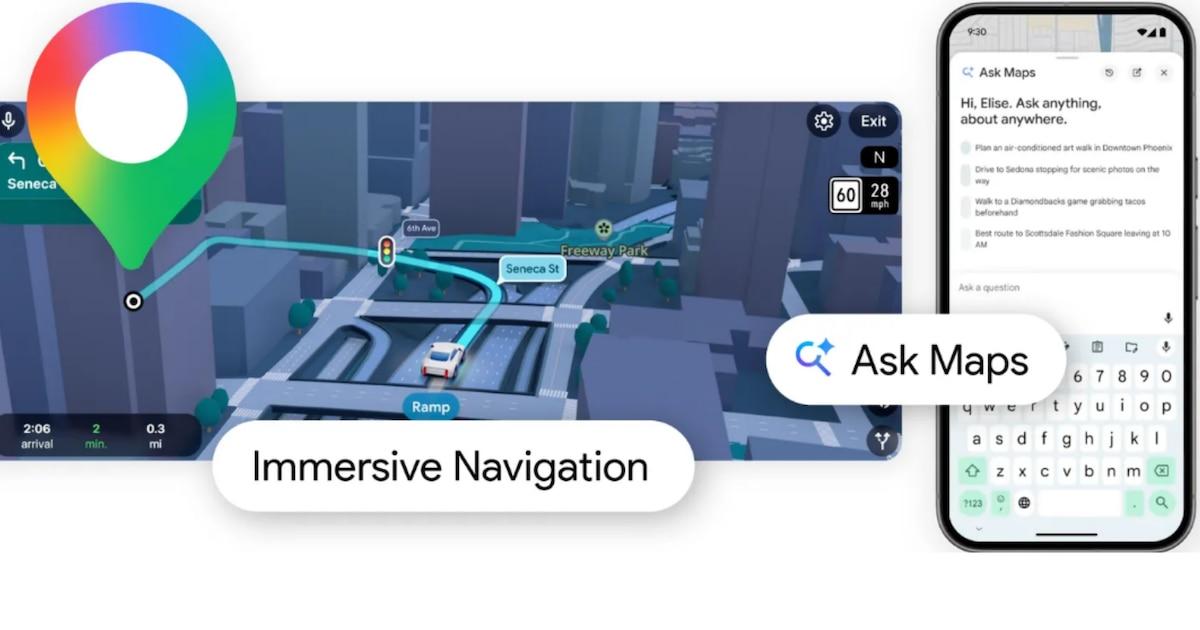
Find a place nearby, like a restaurant while traveling or a socket to charge your mobile phoneUsing Maps is often more complicated than it seems: filters, reviews, maps full of icons, and the feeling of not being entirely sure which option is best. Google wants to turn that experience around with a major Maps update that focuses on artificial intelligence.
The company has unveiled a renovation that combines a conversational assistant called Ask Maps and a Immersive 3D Navigation This completely changes the way we view routes. All of this is supported by Gemini AI models, with the idea that the map will cease to be a simple plan and become a companion that understands complex questions, anticipates needs, and provides more natural assistance on every journey.
Ask Maps: Talk to the map like you would to a virtual assistant
Ask Maps is Google's big conversational bet within its maps application: It allows you to ask questions in natural language directly on the map.without having to try out keywords or navigate through endless results. In practice, the search box transforms into a kind of chat integrated into the app.
Instead of simply typing "restaurants" or "gas station," you can ask much more specific questions, such as "Where can I charge my phone without having to queue for a coffee?" or "is there a public tennis court with lights to play on tonight near my hotel?". The system understands the context, cross-references data, and returns a personalized map with the most relevant options.
To achieve this, Google Maps It combines Gemini's AI with its database of over 300 million places Spread across the globe and enriched by the contributions of a community of over 500 million users who upload photos, reviews, and ratings daily, all this information is processed in the background to provide answers that are not only accurate but also practical.
The suggestions are tailored to each user: Ask Maps takes into account previous searches, saved places, and preferencesIf someone frequently searches for vegetarian restaurants, for example, the recommendations will tend to prioritize that type of cuisine; if they save many hiking routes, the system will more often suggest outdoor activities.
Another important difference compared to classic searching is that You don't have to leave the chat to take actionFrom the same conversation, you can book a table at a restaurant, save a place to a list, share a location with friends, or start a route by car, public transport, or on foot, all without changing screens.
Immersive Navigation: much clearer 3D routes
The other big news is the arrival of the so-called Immersive NavigationA complete redesign of Google Maps' GPS mode, primarily focused on driving, both on mobile devices and in systems like Android Auto, Apple CarPlay, and cars with integrated Google services. The goal is for the map to more closely resemble what the user actually sees out the window.
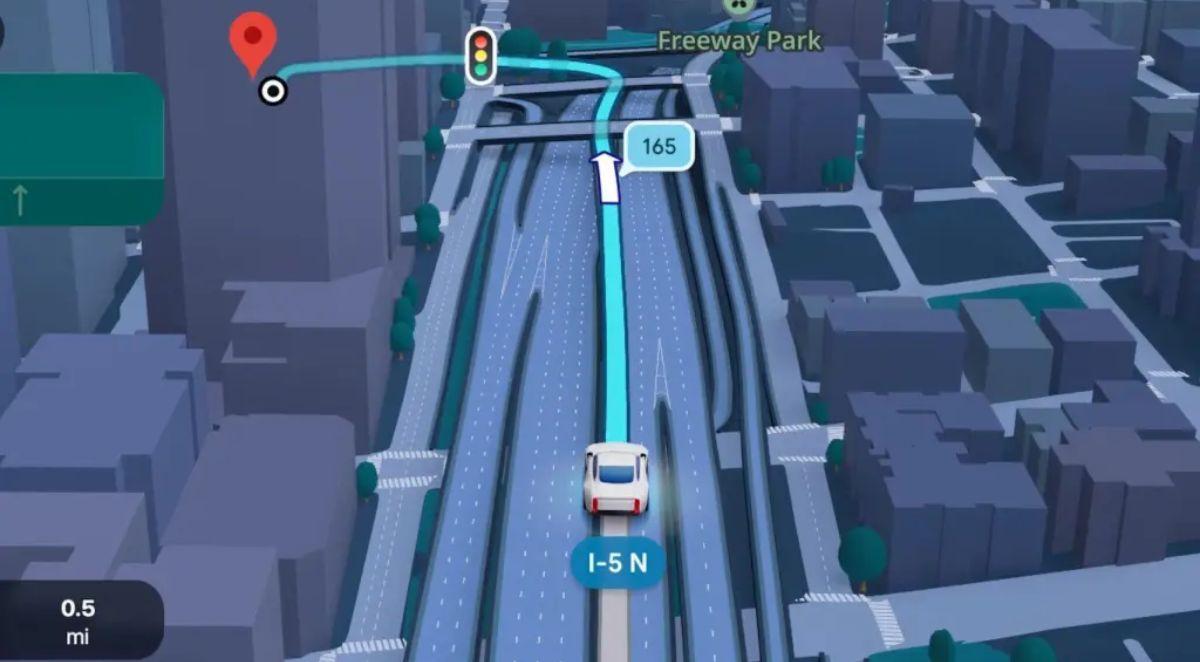
To do this, the app builds a three-dimensional environment with buildings, bridges, tunnels and terrain relief, similar to virtual and augmented realityComplex intersections are no longer just a simple 2D line: the system shows differentiated lanes, overpasses, merges and exits in much greater detail, helping to reduce last-minute doubts, especially on highways with several exits in a row.
The 3D representation is generated from Millions of Street View images and aerial photographs processed by GeminiThe AI identifies key road elements—traffic lights, pedestrian crossings, medians, stop signs—and highlights them when relevant. This allows the driver to more easily recognize the exact point where they need to turn or change lanes.
To prevent buildings from blocking the route, Google Maps applies a kind of “intelligent transparency”When a major maneuver is approaching, nearby buildings become translucent and the system widens the field of view to clearly show where the road ahead lies. This magnified view, with automatic zoom, helps anticipate complex turns and exits with several extra seconds of margin.
The sound also changes. The voice prompts have been redesigned to sound more natural and contextual.In addition to the typical "turn right in 200 meters" instruction, the system can indicate things like "don't take this exit, it's the next one," or rely on visual references in the surroundings such as "turn after the gas station" when that is clearer than an exit number.
Smarter routes, real-time traffic, and door-to-door assistance
The Google Maps update goes beyond aesthetic changes. The company has strengthened route and traffic analysis so that The system better explains the available alternativesIt does not simply offer several options, but details the advantages and disadvantages of each: for example, a slightly longer route but with less congestion, versus a faster one but with a toll or a higher risk of traffic jams.
To make those decisions, the app It processes millions of traffic updates every second on a global scale.In addition, the system receives real-time alerts from the driving community itself, reporting accidents, roadworks, lane closures, and other incidents in a way very similar to what already happens with services like Waze. With this information, the system can recalculate the route and avoid unpleasant surprises along the way.
One of the points where Google places special emphasis is on the last leg of the journeyThis is often the moment when the most questions arise: where exactly is the entrance, which side of the street is best to stand on, or where to park without driving around endlessly. Before leaving, the user can Preview the area with Street View imagesLocate the building's entrance and see nearby parking.
During the approach to the destination, the map clearly marks the side of the road where the chosen site is located, its main access, and nearby parking options. This combination of preview, immersive navigation and detailed guide It seeks to reduce the stress of the last few minutes of travel, both in the city and in unfamiliar areas.
In the case of cars, integration with Android Auto, Apple CarPlay and vehicles with Google built-in This system displays all the information on the car's screen, with a layout designed to minimize distractions. The perspective, level of detail, and directions are adjusted to the context, giving the driver the feeling that the central screen is almost a window to the real world rather than just a traditional GPS.
Gemini as the engine of the new generation of maps
Both Ask Maps and Immersive Navigation rely on Gemini, Google's family of AI modelsIn the realm of maps, Gemini does not simply generate text: it interprets recent Street View images, aerial photographs, and large volumes of geospatial data to build an accurate, near real-time representation of the environment.
In conversational mode, Gemini understands complex questions and translates them into concrete instructions. that the map system can run, like others AI applicationsFor example, if someone asks for "a quiet restaurant with a terrace and near a subway stop," the AI combines information on opening hours, reviews, business tags, public transport, and the user's previous behavior to filter the results and display them directly on the map.
This integration of artificial intelligence also presents new challenges. In a navigation system, AI errors or “hallucinations” can have practical consequencessuch as taking a person to the wrong place or a closed street. Therefore, Google emphasizes that the answers generated by Ask Maps are based on verified data from its own map database and information from verified sources, and that the model is trained with special care to minimize errors in mobility contexts.
Globally, the company is unifying Gemini's presence across various products—from search to Workspace—and now also in Maps. The user experience is that the same AI that answers emails or helps to draft documents It is the one that now makes it easier to find a quiet terrace or the correct exit from a motorway in a new city.
For local businesses and services that rely on physical traffic, this evolution means that the quality of information in Google Maps and Google Business Profile It will be even more decisive: the more complete and up-to-date the listings are, the more likely they are to appear in the answers generated by Ask Maps when someone asks an open question.
Deployment and arrival in Spain and Europe
For now, both Ask Maps and Immersive Navigation They have begun to be deployed in the United States and, in the case of the conversational assistant, also in India.on Android and iOS devices. The desktop version will receive these features later, as the experience matures.
Google has confirmed that The expansion will be gradual into other markets.This includes Europe and Spain, as 3D data coverage is completed and AI responses are tailored to each region. In Europe, aspects such as signage, speed limits, and low-emission zone regulations will require specific adaptations to the directions.
Regarding compatibility, Immersive Navigation will be activated in Eligible iOS and Android devices, infotainment systems with Android Auto and CarPlay And in cars that come with Google as standard. The experience will be the same whether you use your phone mounted on the dashboard or the vehicle's integrated screen.
Meanwhile, users in Spain and other European countries will continue to see the current version of classic navigation and traditional text search. However, The company intends to roll out these features to more regions in the coming months.Therefore, it is expected that 3D mapping and conversational responses will gradually begin to appear in European cities as well.
When the rollout is complete, the everyday use of Google Maps will change significantly: It will move from typing individual words into a search box to having a conversation with the map.And the 3D view will make it easier to navigate unfamiliar neighborhoods, exit a tunnel, or find the exact entrance to a building, whether you're driving or walking.
Taken together, the arrival of Ask Maps and Immersive Navigation represents a significant leap in how Google Maps is used: the application ceases to be a simple two-dimensional browser and becomes a richer conversational and visually richer tooldesigned to reduce uncertainty when moving around the world and to make every decision — from where to have dinner to which exit to take — a little better informed.