- Educational puzzles develop logic, creativity, lateral thinking, and self-esteem in children and adults.
- There are logic, mathematical, visual and lateral thinking puzzles, with varying levels of difficulty.
- They are a fun and highly effective tool for learning as a family and in the classroom, based on science.
- They can be used in meetings, classes, trips and daily routines to train the mind in a fun way.
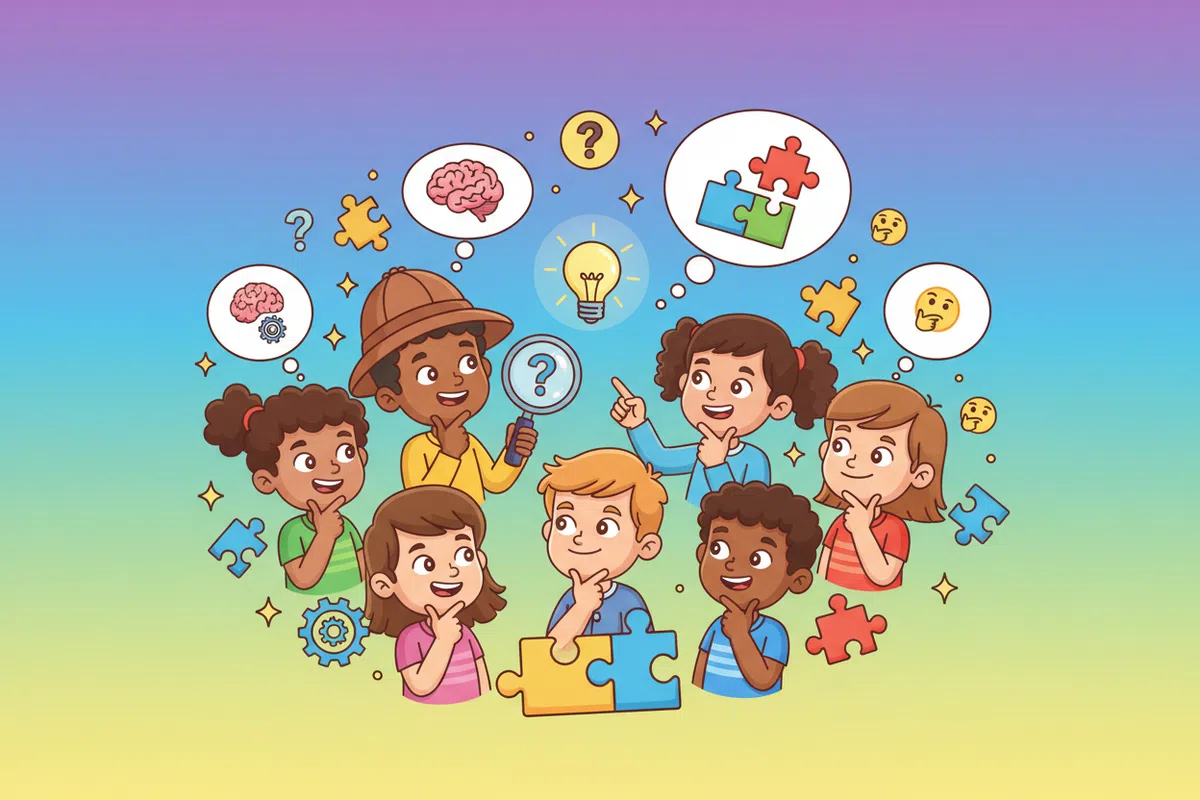
Educational riddles , puzzles, and brain teasers are much more than just a pastime: they are small mental exercises that push our logic, attention, and creativity to the limit, in both children and adults. Solving a riddle requires pausing, observing, connecting the dots, and often, rethinking the problem.
Besides being a very inexpensive and accessible form of entertainment, riddles are a powerful educational resource at home and in the classroom. They help improve mathematical reasoning, language, memory, and even social skills when done in groups. Let's take a comprehensive look at different types of riddles, examples with solutions, and why they are so beneficial for development.
Logic puzzles: thinking “outside the obvious”

Logic puzzles are those where the key lies in correctly interpreting the statement and avoiding common-sense traps. They usually have a very simple answer… once you know it, of course. They greatly enhance the ability to observe calmly and question assumptions.
For example, there are classic riddles like the one about the ducks: “There are two ducks in front of a duck, two ducks behind a duck, and one duck in the middle. How many ducks are there?” Most people answer with large numbers, but the correct solution is three . If you draw the scene, you'll see that the same family of three ducks fulfills all the conditions.
Another classic is the train that derails right on the border between two countries. The question is: "In which country do they bury the survivors?" The logic immediately becomes clear when you stop to think about it: the survivors aren't buried , because they're alive.
Riddles that play with months, ages, and dates are also very popular . For example: “The day before two days after tomorrow is Saturday, what day is today?” If you rearrange the information, you discover that today must be Friday . This type of problem forces you to mentally order the timeline.
Or the one about families: “A mother has five daughters and each one has a brother. How many children does she have in total?” Many answer ten without thinking, but all the daughters share the same brother, so the mother has six children in total.
Historical and literary riddles: from the Sumerian world to the Sphinx
It may seem like a modern invention of social media, but riddles have accompanied humanity for millennia. Some 4.000 years ago, the Sumerians were already leaving enigmas written on clay tablets. One well-known riddle asks: “There is a house. You enter blind and leave seeing. What is it?” The answer is school , a beautiful metaphor for the value of knowledge.
In classical literature, the prime example is the riddle of the Sphinx that Oedipus encounters: "What creature walks on all fours in the morning, on two legs in the afternoon, and on three legs in the evening?" With a little reflection, it becomes clear that it refers to human beings : they crawl in infancy, walk upright as adults, and use a cane in old age.
These historical examples demonstrate that logic puzzles have always been a way to test ingenuity and convey profound ideas in a playful manner. Integrating some of these classic riddles into history or language classes helps connect content in a highly motivating way.
Short riddles to break the ice in a group
Short riddles are ideal for group activities , family gatherings, parties, or classroom tutorials. They don't require pencil or paper and can be tossed out to see who reacts first.
One of the most famous in Spanish goes: “If you lay me down, I am everything; if you cut me in half, I am nothing. What am I?” The solution lies in how we write the zero: when laid down, it suggests the infinity symbol, and when cut in half, it gives the impression of nothing . It's a play on mathematical and visual language.
Others play with everyday situations, like the taxi driver going the wrong way and not being stopped by the police. It all comes down to the fact that the man is walking, not driving. The trick lies in the intentional ambiguity of the statement.
There are also some very theatrical narrative puzzles: a man enters a bar, asks for a glass of water, and the bartender points a gun at him; the customer thanks him and leaves. The logical explanation is that the customer had hiccups and the fright cured them, so he no longer needed the water.
This type of micro-story trains lateral thinking : the answer does not appear by following the "normal" solution, but by imagining alternative contexts that also fit with the available information.
Logic puzzles for children (and adults) with solutions
Logic puzzles where the "trick" lies in some detail of the problem work especially well with young children. The key here is to read slowly and not take anything for granted. The fun part is that, often, children are faster than adults.
A good example is that of the biblical animals : “How many animals did Moses take into the ark?” Many people jump to numbers, but the point is to realize that it was Noah, not Moses, who took the animals into the ark. The mistake lies in the initial assumption.
Another gem for children is the one about kilos of iron and feathers: "Which weighs more, a kilo of iron or a kilo of feathers?" Common sense tells us that iron is heavier, but we're not comparing materials, but rather the same unit of weight . A kilo always weighs a kilo, no matter what it is.
Many riddles also involve eggs and roosters: if a rooster lays an egg on the roof and the wind blows to the right, which way will the egg fall? The humor comes when you realize that roosters don't lay eggs . The statement poses an impossible problem.
For slightly more advanced levels, you can pose riddles such as "a prisoner is saved if they manage to say a sentence that breaks the executioner's logic," or stories about three people (grandfather, father, and son) who appear to be four due to the way the situation is framed. All of this reinforces the ability to deconstruct logical traps and explain why an answer makes sense.
Riddles for young children: play, humor and language
With preschool and early elementary school children, it's best to use very simple riddles with wordplay and absurd humor . The important thing is not that they are difficult, but that they spark curiosity and a desire to participate.
For example: “What does a cow do when the sun comes out?” Answer: It casts a shadow . Or “What animal jumps higher than a house?” The logical answer is all of them, because houses don't jump. Here, the teacher plays with very clear mental images for them.
The world of animals and well-known characters is also frequently used: the Tooth Fairy as "the animal with the most teeth," or explaining that dogs carry bones in their mouths "because they don't have pockets." These are answers that break expectations and provoke laughter.
Other simple riddles help to work on vocabulary and letters, such as "What is in the center of Paris?" whose answer is the letter R , or "Where does Thursday come before Wednesday?", which refers to the order of the alphabet. These are mini-games for phonological and spelling awareness.
These types of puzzles, although they may seem very basic, reinforce symbolic language , the ability to pay attention to details, and a taste for verbal play, which will later facilitate the reading and understanding of more complex texts.
Mathematical riddles: numbers, operations and reasoning
Mathematical puzzles are a powerful way for children (and adults alike) to become more comfortable with numbers. Here, math is presented as a game of ingenuity , not as a list of rote exercises.
Some are based on numerical series : for example, taking a four-digit number and generating the next one by moving the last digit to the beginning (3829, 9382, 2938, 8293…). Discovering the rule of formation forces you to look at numbers as patterns, not as isolated objects.
Other problems play with ages and time differences: “When my father was 31, I was 8; now he is twice my age, how old am I?” If you keep the age difference and use it as a reference, you will see that you are 23 and your father is 46. It is a good example of how to translate everyday language into simple equations.
There are also riddles about probability and combinatorics , like the classic drawer with black and white socks. If you blindly draw three socks, you're bound to get at least one pair of the same color. You don't need to know advanced theory; simply analyzing the possibilities is enough.
Puzzles featuring pictures of fruit, coffee cups, or emoticons that represent numbers are very popular. The task is to deduce the value of each symbol using various equations. This helps develop the use of chained equations and, above all, attention to detail, because the number of elements sometimes changes (for example, from two cookies to one).
Mathematical problems that fool almost everyone
There are certain number riddles that have gone viral because the vast majority of people get them wrong on the first try. A good example is the bat and ball riddle: “A bat and a ball cost €1,10. The bat costs €1 more than the ball. How much does the ball cost?”
The intuitive answer is that the ball costs 10 cents , but if you do the math, you'll see that the bat would then cost €1,10, bringing the total to €1,20. The correct answer is that the ball costs 5 cents and the bat €1,05. This problem is often used in psychology to illustrate how quick intuition can sometimes lead us astray.
Another classic is the machines and items problem : if 5 machines make 5 pieces in 5 minutes, how long will it take 100 machines to produce 100 pieces? Our temptation is to do complicated proportional calculations, but the correct reasoning is to see that each machine takes 5 minutes to make 1 piece, so 100 machines will also make 100 pieces in 5 minutes.
The farmer's problem of "one and a half hens, one and a half eggs in one and a half days" is also well-known. The rigorous way to solve it results in a hen laying two-thirds of an egg daily , a good example for working with production ratios and rates.
Even seemingly common-sense issues, such as the famous "missing euro monster" on a hotel bill, help to understand the importance of adding and subtracting correct amounts , without mixing up concepts (what the customers paid, what was refunded, what the bellboy kept...).
Very difficult logic and lateral thinking puzzles
Once you've mastered the basics, you can move on to more complex puzzles, where logic is combined with lateral thinking . Here, you not only have to apply rules, but also break the mold and look at the problem from a different angle.
Among the most famous is the so-called "Einstein riddle," featuring five houses of different colors, owners of different nationalities, drinks, pets, and tobacco brands. Using 15 linked clues, you have to deduce who owns the fish. It's solved with logic tables and cross-referencing possibilities, and it's often said (perhaps with a touch of legend) that only a small percentage of the population can solve it without help.
Another type of difficult puzzle involves combining time and limited resources . For example, measuring exactly 45 minutes using only two ropes that take an hour to burn but burn unevenly, and a lighter. The solution involves lighting the ropes at both ends at specific times and taking advantage of the fact that, by lighting them at both ends, the time is reduced by half.
There are also the puzzles with light bulbs and switches : three switches downstairs, one light bulb upstairs that you can only access once. You have to use the heat of the bulb (not just the light) to figure out which switch controlled it: one is left on for a while, then turned off and another is turned on; when you go upstairs, the state (on, off and hot, off and cold) reveals which switch is which.
And there's no shortage of logic puzzles about islands where some inhabitants always tell the truth and others always lie, or about guardians and gates where, with a single well-formulated question, the correct path can be discovered. These are excellent for developing metacognition : thinking about how we think.
Visual and observation puzzles
Visual puzzles, those where you have to find a hidden character or detect a pattern in a geometric figure, are perfect for training selective attention and spatial perception . They work great both on paper and projected onto a screen.
Very popular have been the drawings where you have to find a panda among hundreds of snowmen, a cat camouflaged among owls, or a movie statue among space soldiers. At first glance it seems like chaos, but with patience you find the odd one out. This type of challenge demonstrates that children are often more observant than adults.
This category also includes puzzles involving counting geometric shapes : How many triangles are in this image? How many squares are hidden within a pattern? It's common to underestimate or overestimate the actual number because we often miss compositions of large shapes made up of several smaller ones.
There are even matchstick puzzles, where you have to form a specific number of squares by moving only a certain number of matches, or clock puzzles where you have to deduce the time on the fifth clock based on how the previous ones run slow. All of these require handling both visual and numerical information simultaneously.
Finally, there are the "trick" visual puzzles, like the one with the bus drawn the same on both sides: they ask which way it's moving, and the clue is that there are no doors visible in the drawing. If you think about where the doors are in your country, you can deduce which way the vehicle is moving in the image.
Paper riddles, geometric games and homemade puzzles
It's not all numbers and clever phrases. There are also hands-on puzzles with paper, scissors, and pencil that are perfect for workshops or rainy afternoons. One particularly interesting one involves folding and cutting a sheet of paper in a certain way to create a "trick" that seems impossible to replicate if you don't know the hidden folds.
Other classic puzzles require connecting nine dots with four straight lines without lifting your pencil or passing through the same dot twice. The solution lies in extending the lines beyond the imaginary square formed by the dots, something many people initially hesitate to do because their brains "confine" the problem within that frame.
You can also create math puzzles with numbered triangles and circles: for example, placing the numbers 1 through 6 at the corners and midpoints of a triangle so that each side adds up to 9, 10, 11, or 12, or even creating a crossword puzzle . By changing the target sum, you can create various challenges with the same materials.
Another simple but very powerful idea involves balance scale problems using geometric figures or icons. Several balanced scales are shown, and the last one is missing a value that needs to be deduced. To solve it, you have to translate the drawing into logical equations of the type "one rhombus equals two triangles" and then substitute the values.
These types of homemade materials, in addition to being entertaining, allow you to work on the graphic representation of operations and are ideal for the math classroom or for sessions at home with few resources.
Educational benefits of riddles and puzzles
Beyond being entertaining, riddles have a real impact on children's cognitive and emotional development. They are, quite literally, a mini- gym for the brain , working on several abilities at once.
First, they stimulate logical and critical thinking . Solving a puzzle requires analyzing data, ruling out possibilities, looking for inconsistencies, and justifying an answer. It's the same type of reasoning needed later for mathematics, science, or everyday life.
Secondly, they strengthen vocabulary and reading comprehension . Many riddles are based on double meanings, phonetic games, or unusual expressions; to understand them, the child expands their linguistic repertoire almost without realizing it.
They also have a very positive impact on self-esteem . When a child manages to solve a riddle on their own, they experience a clear sense of accomplishment, which reinforces their confidence in their abilities. This small success encourages them to take on increasingly demanding challenges.
Furthermore, riddles are excellent for social interaction . Posing them with family, friends, or in class fosters cooperation, active listening, taking turns, and a love of sharing discoveries. They often become a fun group ritual.
Lateral thinking: what it is and how puzzles train it
Many of the puzzles we have seen are not solved solely with "step-by-step" logic, but with what is known as lateral or divergent thinking, a term popularized by psychologist Edward de Bono.
This approach involves abandoning the most obvious mental path and exploring alternative routes. Instead of mechanically applying what has been learned, the brain "jumps" out of its usual pattern and proposes creative solutions. This is crucial when the same old problems no longer work.
Riddles are an ideal training ground because they force you to check assumptions (what if the rooster couldn't lay eggs?, what if the man in the hotel was playing Monopoly?), to formulate the right questions and to critically examine the answers that come to mind at first.
Furthermore, they combine creativity with rigorous logical thinking . Not just any outlandish idea will do: the solution must fit with all the given information. This blend of imagination and discipline is invaluable in fields as diverse as science, design, and conflict resolution.
Training lateral thinking from childhood, through brain teasers and puzzles, helps children face their own everyday problems with more flexibility and resources , instead of getting stuck at the first sign of difficulty.
How to use educational riddles at home and in the classroom
Integrating riddles into daily life is much easier than it seems. You don't need to organize long sessions; simply take advantage of small moments of downtime : in the car, while waiting at the doctor's office, before going to sleep, or during the first few minutes of class.
As a family, you can establish "daily challenges": each afternoon someone poses a riddle to the rest of the family, and the next day, the solution is reviewed. This encourages everyone's participation, including the children, who can invent their own riddles.
In the classroom, riddles work very well as warm-up activities in math, language arts, or tutoring. A 5-minute riddle at the beginning of class activates the group's minds, generates conversation, and can be connected to the curriculum content (logic, word problems, sentence comprehension, etc.).
They are also a great resource for formative assessment : rather than focusing on whether the student gets it right or wrong, you can analyze together what strategies they used, where they got stuck, what assumptions they made… This teaches them to think about their own thinking.
And of course, they remain a perfect wild card for gatherings and parties . A good repertoire of riddles of varying difficulty guarantees laughter, friendly competition, and a fun time that, almost imperceptibly, is giving everyone a workout.
Educational riddles, from the simplest children's puzzles to the most challenging logic puzzles, form a universe of games that combines fun and learning in equal measure. Using them regularly at home or in the classroom is an easy way to keep the brain active, strengthen logic, language, and creativity, and, incidentally, share moments of camaraderie where children and adults challenge each other, laugh at their own blunders, and discover that thinking can be as entertaining as any video game.