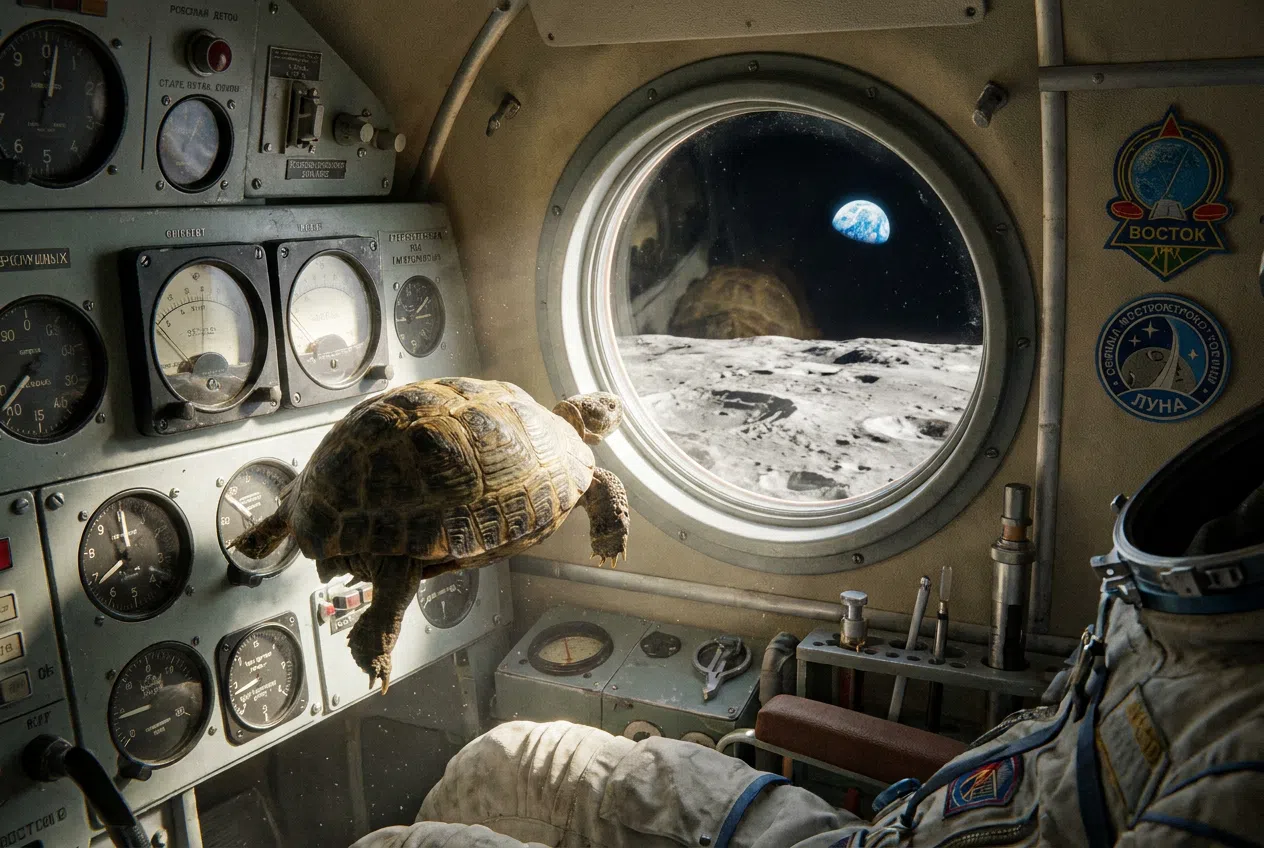
- The Soviet tortoises of the Zond 5 mission were the first living beings to orbit the Moon and return to Earth.
- Various animals, from flies and dogs to primates and mice, were essential to validating human survival in space.
- The Moon has a biological influence on Earth, regulating coral spawning and the hunting and escape behavior of nocturnal species.
When we think about space exploration, the first thing that comes to mind is the brave astronauts who set foot on the lunar surface. However, the story is much more curious and diverse, since before humans , a variety of animals were the true pioneers in facing the cosmic void and the radiation of deep space.
From tiny flies to dogs and primates, wildlife has been the biological shield that allowed Earth's powers to understand whether it was possible to survive outside our atmosphere. It's not just about who got there first, but about how these often-forgotten creatures paved the way for science to advance by leaps and bounds.
Russian tortoises: the first visitors to the Moon
Although Apollo gets all the fame, the honor of being the first living beings to orbit the Moon belongs to the tortoises of the Soviet Zond program . In September 1968, the Zond 5 mission carried two specimens of the species Testudo horsfieldi into space , chosen specifically for their ability to withstand long periods without food and their low oxygen consumption.
The journey was a true odyssey. The spacecraft suffered malfunctions in its orientation sensors, forcing ground controllers to maneuver using solar sensors. After passing about 1950 kilometers from the far side of the moon, the tortoises endured a violent reentry with accelerations of up to 16 Gs and external temperatures of 1300°C. Despite the ordeal, they returned alive, although one of them lost an eye in the process. Later, Zond 7 also successfully brought back four other tortoises.
Other animals that orbited the satellite
It wasn't just reptiles that ventured so far. The Americans also sent animals on their Apollo missions. Apollo 16 carried nematode worms, while Apollo 17 took five dwarf mice ( Perognathus longimembris ) as part of the BIOCORE experiment. These small rodents, affectionately nicknamed Fe, Fi, Fo, Fum, and Phooey by the astronauts, were used to study the effects of cosmic radiation on living tissue, although one of them died during the journey.
The Road to Space: Pioneers and Tragedies
Long before the moon landing, the space race began with more modest but dangerous experiments. In 1947, the United States launched the first fruit flies aboard a V-2 rocket, reaching an altitude of 109 km. It was the first step in analyzing how radiation affected living beings at extreme altitudes.
The USSR, for its part, became famous thanks to its space dogs. The most remembered is Laika , who in 1957 became the first animal to orbit the Earth, although she sadly died due to stress and a cooling failure. Other dogs like Belka and Strelka were luckier, becoming the first mammals to return alive from Earth orbit.
- Astronaut primates: The United States used rhesus monkeys and squirrel monkeys, such as Albert II or Ham the Chimpanzee, to test control and survival systems.
- International contributions: France sent Felix the cat and rats; Argentina stood out with Juan the Monkey; and China also launched dogs and rats in the 60s.
- Biological diversity: Everything from bullfrogs and mummichog fish to spiders, ants, and chicken embryos has been sent into space.
The influence of the Moon on terrestrial fauna
Beyond space travel, the Moon exerts a fascinating control over animals that remain on Earth. The light of a full moon acts as a biological clock , regulating critical processes. A striking example is the mass spawning of corals in the Great Barrier Reef, where lunar illumination coordinates the release of gametes to ensure fertilization.
On land, a contradictory phenomenon occurs. Nocturnal predators, such as leopards and owls, take advantage of increased visibility to optimize their hunting . Conversely, many prey animals develop what is called moon phobia , reducing their movements to avoid being easily detected in the bright light, which disrupts the feeding cycles of the entire ecosystem.
Private explorations and recent missions
In more modern times, exploration has passed into private hands. Bigelow Aerospace launched modules like Genesis I and II, carrying hissing cockroaches from Madagascar and South African scorpions into space. Even live nematodes were found in the Columbia shuttle disaster, demonstrating the incredible resilience of some microscopic organisms under extreme conditions.
The story of animals in space and their relationship with the moon is a tale of unwitting bravery and scientific curiosity. From the turtles that were the first to orbit the moon to the corals that synchronize their life cycles with its phases, wildlife has been and continues to be fundamental to understanding the cosmos and the biological balance of our own planet.