- Prairies introduces a Steppe biome with Soil Stress and fires that transform fire into a key tool for progress.
- More than 65 new biotas, complex food chains and the giant Jangwa change the focus towards dynamic management of mobile resources.
- Four new leaders and three alternative eras redefine goals, starting pace, and cultural evolution of humanity.
- The DLC expands the strategic and narrative depth of Reus 2 without sacrificing its relaxed tone or excellent technical performance.
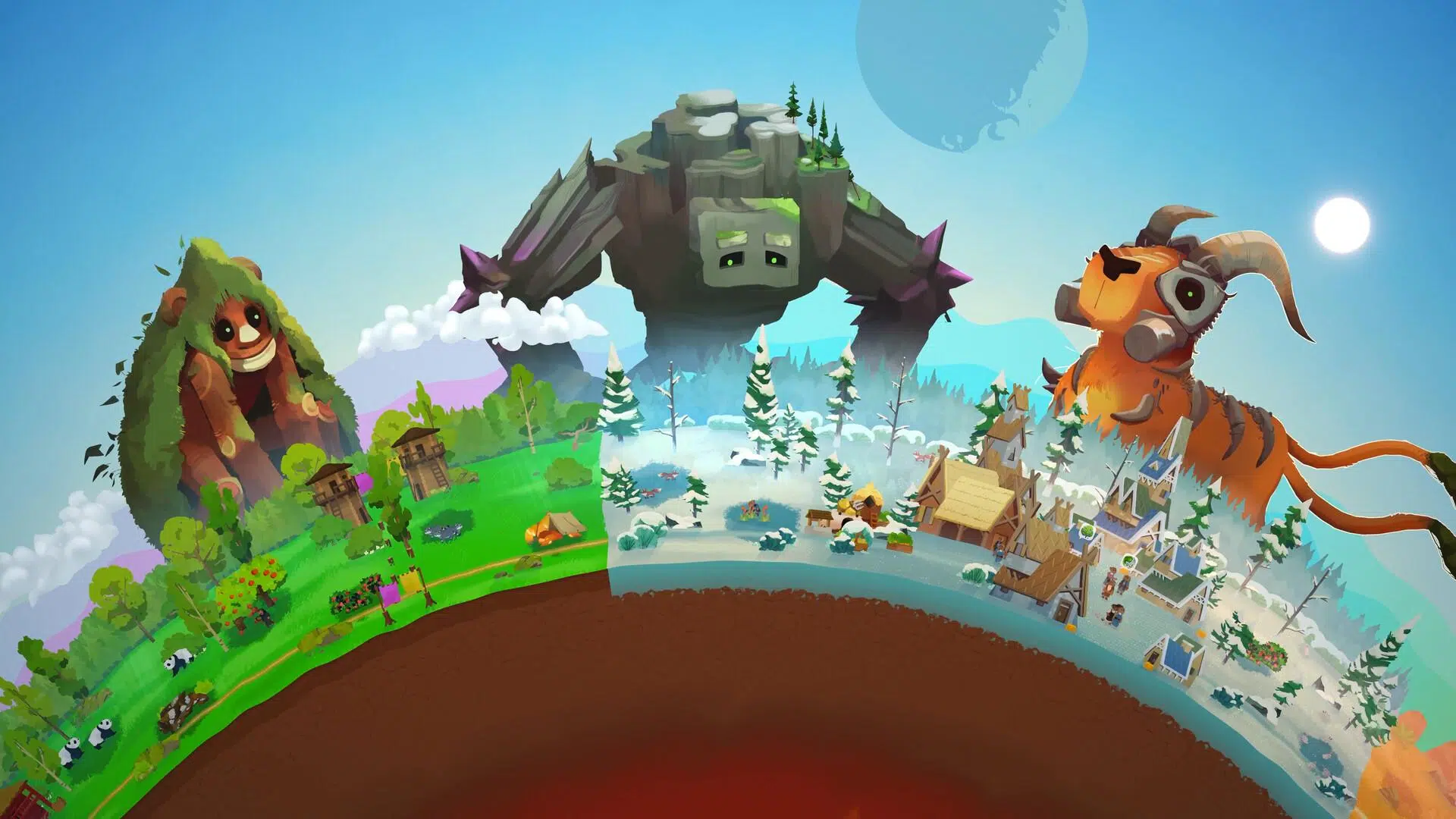
If you've ever thought that strategy games are all about building without destroying anything , the Grasslands DLC for Reus 2 is here to give you a good talking-to. Here, fire ceases to be a punishment and becomes your most powerful tool for making nature grow stronger than ever.
This additional content for Reus 2 isn't just about adding four new biomes; it reinterprets the "god game" concept introduced in the original. You're still a divine entity guiding humanity through elemental giants, but now the game invites you to embrace chaos, accept controlled destruction , and play with the cycles of life and death in a steppe ecosystem that, on paper, seems friendly and fertile… until you start meddling.
What is Reus 2: the base before entering Praderas
Before diving into the expansion, it's worth remembering what the base game offers: in Reus 2 you embody a superior entity that controls several giants, each linked to an element and a type of biome, with which you shape procedurally generated planets.
These titans don't command armies or units in the style of StarCraft, Age of Empires, or Civilization . Instead, they shape the terrain by placing plants, animals, and minerals that form biomes like forests, tundras, deserts, and oceans. Humans then organize themselves on this foundation, building villages, prospering, or failing depending on how they combine resources and synergies.
The beauty of the system lies in the fact that each element has positive and negative effects depending on its surroundings: one plant can enhance another, a mineral can boost food production, or an animal can unleash an environmental disaster if introduced where it shouldn't be. All of this makes each planet a systemic puzzle full of synergies , where your role is more that of a cosmic gardener than a battle general.
Furthermore, as you replay the game, it unlocks new biomes, biota, and divine abilities, making each subsequent world more complex, challenging, and rich in possibilities . This replayability, based on trial and error, is at the heart of the experience: each civilization can evolve from a primitive tribe to a hyper-advanced, spiritual, industrial, or scientific society, depending on how you've configured their world.
Grasslands: a biome that turns fire into an ally
The Grasslands DLC adds a new steppe biome that, on the surface, seems like a peaceful place to plant crops and forget about it. In reality, it's the most unstable and risky environment in all of Reus 2, because it introduces the core mechanics of Soil Stress and Fire.
In this new environment, each time you place biota (animals, plants, or minerals from the steppe), the terrain gradually accumulates stress . If that bar reaches its maximum, sparks fly and a fire breaks out, potentially spreading to neighboring plots and instantly destroying everything you had so carefully built in that area.
The interesting twist is that this fire isn't conceived as a simple punishment, but as a mechanism for ecological renewal . The scorched earth is transformed into Ashland, a much more fertile type of soil in which improved versions of flora and fauna can emerge—often called survival mutations—capable of yielding twice the production of food, scientific advancements, or other key resources.
Thus, playing in Prairies becomes a constant risk-reward gamble: you can try to keep stress under control to maintain a stable ecosystem, or force fires at the opportune moment to make a brutal evolutionary leap at the cost of a few minutes of controlled chaos.
This design breaks with the "safe" mindset that many Reus 2 veterans had perfected, forcing you to think not only about optimizing synergies, but also about managing cycles of destruction and rebirth as a natural part of your civilizations' progress.
The Steppe, its biotas and the new ecological synergies
The steppe biome of Prairies, which you can place with the Savannah Giant Jangwa by activating Prairie mode instead of Savannah at the start of the planet, brings with it more than 65 new biotes including animals, plants and minerals suited to that dry and wide environment.
Among these new species you'll find creatures like the bison, the prairie dog, and birds of prey , alongside grasses and flowers typical of the steppe, such as lavender and hardy cereals. These aren't just cosmetic additions: each one comes with its own set of synergies and constraints that fit the logic of a grassland and predator ecosystem.
For example, some predators like wolves or pumas can control herbivore populations , thus reducing the stress caused by an excessive density of animals feeding simultaneously. Certain plants, on the other hand, absorb nutrients accumulated after fires, cleaning the land and accelerating ecosystem recovery.
There are also birds that expand the area of influence of nearby cities or provide bonuses to vigilance and curiosity, with direct effects on how your civilizations expand or investigate . All of this means that simply planting "whatever produces the most" is no longer enough: you have to configure complete food chains where each level (producers, herbivores, predators, and scavengers) has a clear role.
The result is that the map ceases to feel like a static board where you only seek to place optimal pieces, and becomes a living, cyclical and fragile system , which can collapse due to excessive ambition or flourish if you understand when to slow down, when to set fire and when to let the terrain breathe.
Soil Stress, Fires and Ash Land
Soil Stress mechanics are the key difference between the Steppe and other biomes. Every time you add high-performing biotics—like bison, wild wheat, or certain highly productive grasses —soil stress increases, and the stress bar approaches 100%.
When this bar fills up, combustion is triggered: the fire begins to spread to adjacent plots, temporarily burning the biota present. This process may seem like a disaster, but if you keep a cool head, it becomes your most powerful ecological design tool.
The burned plots are transformed into Ashlands , a terrain type that allows for the planting of more resilient and advanced versions of plants and animals. These survival mutations provide resilience bonuses, increased resource production, and generally better long-term synergies.
The key is deciding when it's worth starting or allowing a fire . If you do it too soon, you lose an ecosystem you haven't yet exploited; if you delay too long, the fire's spread can devastate areas critical to a city or a key food chain.
Praderas thus forces you to abandon the fantasy of “eternal stability” and embrace a crisis management model where fires are natural stages in the planet's life cycle , not simply punishments for playing “bad.” In the end, your role is more like that of a responsible pyromaniac god, using the flames to open the door to eras of abundance.
Jangwa: the giant shepherd and the management of resource flow
The expansion also introduces Jangwa in a new facet, a giant associated with the Savannah/Prairie who, in this DLC, receives a renewed visual appearance and a key ability: the ability to swirl and displace entire herds of animals from one point on the planet to another without destroying them.
This ability to "herd" animals radically changes the flow of the game. Until now, many decisions in Reus 2 were quite static: you placed a biota in a specific location, accepted its effects, and tried to compensate with others nearby. With Jangwa, you can turn animals into mobile resources , repositioning them according to the immediate needs of each city.
Imagine a civilization needs a food boost to advance to the next era or unlock a major project. You can move your bison from a distant plain to the edge of that city, take advantage of the production boost, and then, when it's no longer needed, move them to less saturated areas to avoid overexploiting the land.
However, this tool doesn't come without a cost: on large planets, keeping track of herds, optimal routes, and space synergies can require considerable attention. It's not an "automatic" power that can be spammed without thinking, but rather an additional layer of planning that adds micromanagement as well as strategic depth.
Combined with the fire mechanics, Jangwa becomes crucial: you can relocate animals away from areas about to burn, preserve specific species, or bring certain biotas to the newly created Ash Land to fully exploit the new mutations.
Four new leaders: classes with personality and starting styles
Another central element of Prairies is its four additional human leaders, who function as playable classes with their own distinct identities . Each one changes priorities, intermediate objectives, and the pace of the game, affecting how you interpret the mechanics of the Steppe biome.
The Farmer is the closest to a classic and relatively safe playstyle. It focuses on steady growth, food production , and gradual expansion, making the most of the Ashlands' renewed fertility without taking too many risks with extreme decisions.
The Cultist, on the other hand, relies on sacrifices and offerings for immediate gain. Their approach flirts with a dark fantasy tone and religious fanaticism : they can burn resources, populations, or specific biota to feed their Dark Gods and generate wealth or upgrades for the Giants in the blink of an eye.
The Architect mode offers more cerebral gameplay, focusing on placement patterns and megaprojects . It requires you to arrange biotas in specific geometric shapes—rings, lines, symmetrical structures—to unlock advanced buildings and technologies primarily associated with the Celestial Age.
Finally, the Astronaut accelerates the technological leap and propels humanity beyond the planet. Their playstyle encourages you to race toward higher eras with fewer Eons , making better use of advanced biota and guiding your civilizations toward a spacefaring future that challenges even the relationship between humans and Giants.
What's interesting is that these leaders don't function as simple numerical modifiers, but rather they reorder the way you think about your planets: they change what objectives you consider priorities, what risks you accept, and how you approach the use of fire and the Prairie biome from minute one.
Three new eras: fables, faith, and biotechnology
The DLC doesn't just add a playable biome; it also expands the lore and the ultimate fate of humanity with three new alternate eras that act as epilogues, but also as long-term strategic goals.
The City of Fable presents a humanity living surrounded by myths and stories inspired by the local fauna. The legendary animals of the Steppe fuel tales that, in turn, accelerate inventions, cultural projects, and forms of social organization linked to the collective imagination.
The Celestial Planet focuses on a spiritual evolution where faith in the Giants is institutionalized. Cities are built facing the sky, purity and harmony are the core of the culture, and a peaceful religion is founded centered on these divine entities , who see fire as part of a sacred cycle of purification.
The Biokinetic Dream is the most futuristic and transhumanist aspect of the whole. Here, humanity blends technology and nature to the point of blurring the line between organism and machine , creating a dreamlike utopia where fires, mutations, and biomes are integrated into a sophisticated biotechnological fabric.
These eras segment human evolution into three narrative stages—a fabulous past, a spiritual present, and a biokinetic future—and give the feeling that each playthrough is an epic about resilience and adaptation . As a player, you choose what kind of ending you want to guide humanity toward, and your decisions in the Prairies shape that journey from the very beginning.
Emergent narrative: from the myth of fire to human emancipation
One of the most peculiar things about Reus 2 is that its narrative doesn't rely on cutscenes or lengthy dialogues, but rather on how human cultures evolve according to the conditions you impose on them. Each planet is almost an anthropological experiment.
With Prairies, this approach is enriched by the "myth of rebirth through fire." Steppe societies don't see the Fire Giant as a monster, but rather as a kind of aggressive gardener who clears the land so it can grow back . This is reflected in era quests, descriptions, and the game's logic itself.
The Cultist personifies the dark side of that relationship, showing how some human groups interpret the Giants as deities hungry for offerings , while the Astronaut opens the can of emancipation: what happens when humanity has the technical ability to leave the planet and wonders if it still needs its elemental creators?
All of this is complemented by the Cataclysm update, which allows leaders to form bonds with each other and with the Giants , allying, trading, or even waging war. They can even rise up against your Titans by sending Giant Hunters to try and bring them down, something you can respond to with devastating new powers.
Without the need for explicit dialogue, the game ends up building a kind of galactic mythology where each planet is recorded as a legacy in the stars , an independent story about how a particular humanity learned (or not) to live with fire, natural cycles and the power of its gods.
Gameplay, complexity, and learning curve
From a purely gameplay perspective, Reus 2 remains a highly systematic ecosystem puzzle game. You control up to six elemental giants, each with distinct abilities, and unlock new powers as you gain inspiration during gameplay, expanding your terraforming and management options.
Prairies adds several layers on top: stress, fires, the Ashlands, complex food chains, four new leaders, and their unique mechanics. All of this transforms the game from a relatively static placement puzzle into a chaos management simulator, where you often have to react to chained events rather than execute a meticulously planned strategy.
The interface remains dense and cluttered with icons, synergy numbers, requirements, and cross-effects. For newcomers, this can be somewhat overwhelming at first, but if you enjoy delving into complex systems, that density becomes part of the charm. The game isn't "click and play" : it demands reading, patience, and a bit of care when experimenting.
The great thing about Reus 2 is that its overall pace is quite relaxed. While there are tasks tied to specific time or conditions, the general tone is one of calm strategy without a sense of urgency , a far cry from the constant pressure of other titles in the genre. Here, you can afford to try new mechanics, make mistakes, burn half the planet, and try again in the next world.
That blend of deep systems, trial and error, and the freedom to start over makes the learning curve, though steep, incredibly rewarding. When you finally understand how to fit together fire, biomes, leaders, and eras , the feeling of orchestrating a galaxy of coherent worlds is spectacular.
Visuals, sound and performance
In terms of technical aspects and artistry, Reus 2 maintains the picture book aesthetic of the original, with a colorful, clean, and very easy-to-read style. The Prairies DLC integrates seamlessly with this visual style, adding ochre tones, dry greens, and expansive skies that reinforce the sense of the steppe's fragility.
The fire animations are particularly well done: the flames convey danger and urgency, but don't break the game's relaxed tone. Watching Jangwa cross the horizon, with the grasslands burning in the distance and then regenerating, creates visually stunning scenes without requiring a high-end PC.
In terms of sound, the soundtrack takes a minimalist approach, with ambient melodies that adapt to the planet's state and subtle sound effects that reinforce the feeling of interacting with a living world. The sounds of wildlife, human whispers, and the effects of elemental powers add a playful and almost whimsical layer to the experience.
In terms of performance, Reus 2 and its DLC are highly optimized. Even when the planet is teeming with interacting biota, chain-reaction fires, and advanced cities deploying their capabilities, the game remains stable on PC and modern consoles , which is greatly appreciated in a title where readability is key.
This balance between attractive visuals, good optimization, and clarity of information means that, despite the number of systems running, everything is manageable and pleasing to the eye , even in moments of maximum controlled chaos.
In the end, Grasslands establishes itself as an expansion that not only adds content but also reinvents the pace and philosophy of Reus 2. Making fire the driving force of progress, introducing complex food chains, and offering new narrative paths through leaders and alternate eras makes each planet a distinct story of destruction, rebirth, and human ambition—perfect for those who enjoy deliberate, dense, and highly replayable strategy.